Pelvic health explained · English edition
Pelvic-floor pain: why more Kegels may be the wrong starting point
Pelvic-floor exercise is often described as squeezing and strengthening. That can leave a person with pelvic pain wondering why more contractions are not helping—or why the exercises seem uncomfortable.
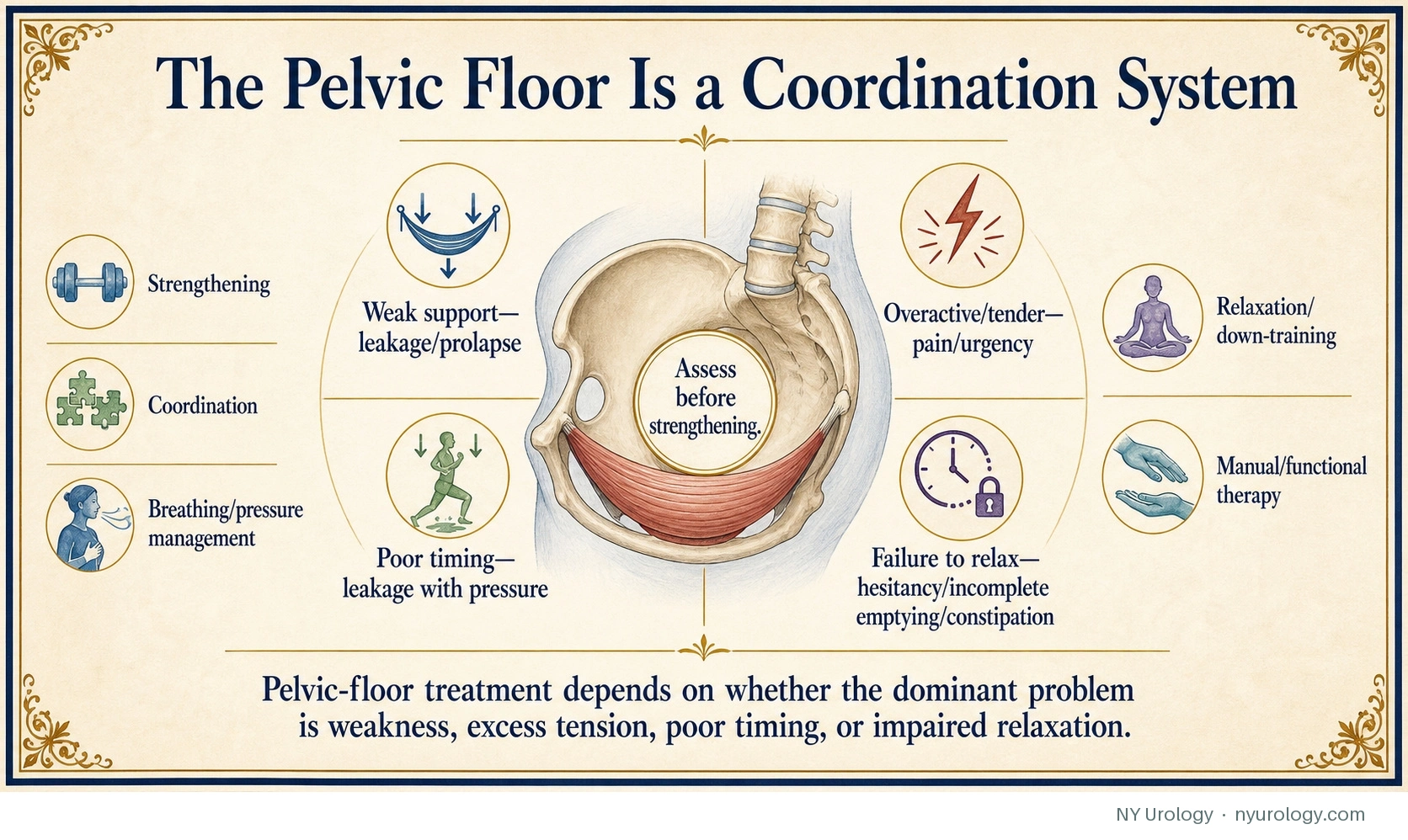
The pelvic floor has to do more than contract. It also needs to release and coordinate with breathing, movement, urination and bowel function. The appropriate starting point depends on what an assessment finds.
Tightness and weakness are different questions
Muscles can be tender, difficult to relax, weak, poorly coordinated or affected by a mixture of problems. Symptoms alone do not reliably separate those patterns. Pelvic pain does not automatically mean the pelvic floor is the cause, and a sensation of tightness does not establish a diagnosis.
That is why a generic exercise routine may miss the target. Before adding more Kegels, ask what the exercise is intended to change and how you will know whether it is helping.

An examination should explain its purpose
A clinician or pelvic-health physical therapist may assess movement, tenderness, resting tension and the ability to contract and release. The examination should be tailored to the problem and explained beforehand.
An internal assessment is not a requirement you must accept without discussion. Consent, the option to stop and possible alternatives should be clear. You can ask whether external assessment or another starting approach would answer the immediate question.
Do not begin forceful internal massage or use internal treatment tools because an online article suggests that a muscle may be involved. A description of anatomy is not a personalized treatment plan.
What treatment may focus on
For a person whose findings support muscle overactivity, treatment may emphasize relaxation and coordination rather than repeated strengthening. The specific approach can include education, breathing or movement work and therapist-directed techniques selected for that individual.
If weakness is part of the problem, strengthening may have a role. The sequence and dose still matter. “Never strengthen” is no more useful as a universal rule than “everyone needs Kegels.”
Pelvic-floor care can be one part of a broader plan. Treating a muscular contributor does not remove the need to address bladder symptoms, bowel problems or another medical condition when present.
Measure something that matters in daily life
Before a treatment trial, choose a practical target: sitting through a meal, urinating with less difficulty, returning gradually to activity or having less discomfort around intimacy. Record whether the plan improves that target, creates new symptoms or is too difficult to follow.
Tell the treating clinician about worsening pain or problems emptying the bladder. The response may require a change in the exercise plan, a medical reassessment or a different referral—not simply trying harder.
Do not assume every pelvic symptom is muscular
New fever with urinary symptoms, inability to urinate, significant bleeding or rapidly worsening pain needs medical assessment. Sudden severe testicular pain is an emergency. These symptoms should not be worked through as an exercise flare.
Ask for an individualized plan
At a NY Urology appointment in Manhattan or Forest Hills, you can discuss whether pelvic-floor assessment belongs in your evaluation. Ask which findings support the referral, what the therapist should assess and how the results will be shared with the clinician coordinating your care.
Related reading and care
- Prostatitis evaluation and treatment
- The pelvic-pain network, illustrated
- Prostatitis and chronic pelvic-pain guide
- Prostatitis keeps coming back after antibiotics: what should be reassessed?
- Normal tests, persistent pelvic pain: what does “normal” actually rule out?
- Your first prostatitis visit: bring a timeline, leave with a plan
- A pelvic-pain flare plan: familiar symptoms or something new?
Sources and further reading
Adapted from Inside the Fire, by David Shusterman, MD. Practice editorial edition, October 29, 2026. These explanations support a conversation with your clinician; they do not diagnose your symptoms.