
Home · Conditions · Overactive Bladder
Overactive bladder
Overactive Bladder
Explore the illustrated guide ↓
Sudden urges, frequent trips, and waking at night aren't something you simply have to live with. The bladder often isn't "overactive" — the signal is. We confirm what's actually driving it, then treat durable-first — including Urgent PC (PTNS), a non-drug, non-surgical, in-office therapy.
A bladder that won't wait — and what's really behind it
Overactive bladder (OAB) is the sudden, hard-to-control urge to urinate, often with frequent trips during the day, waking at night, and sometimes leaks before you reach the bathroom. It's common, it's treatable, and — importantly — it is not one single problem. The same symptoms can come from very different causes, which is exactly why the evaluation matters as much as the treatment.
The bladder isn't "overactive" — the signal is
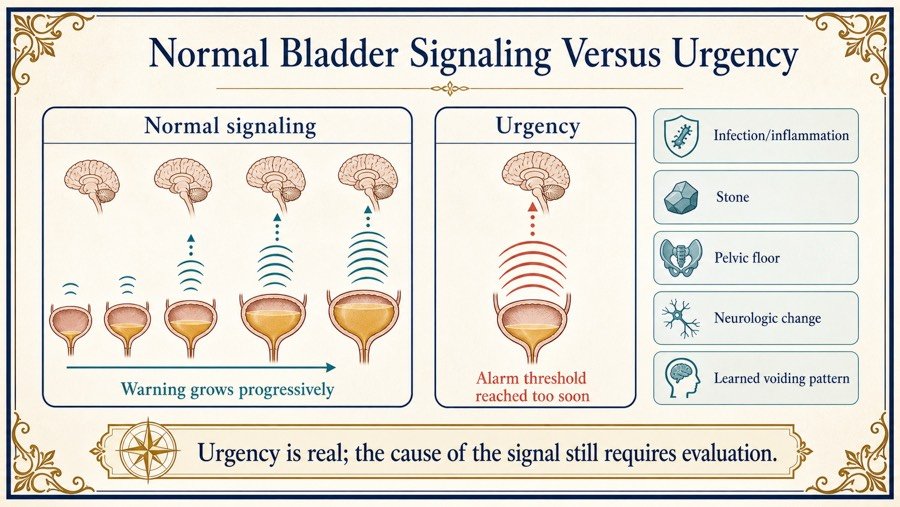
The name misleads. It makes patients picture a muscle spasming out of control, but in a large share of cases the muscle is behaving reasonably and the problem is sensory: the bladder wall is reporting "full" at volumes that shouldn't yet register, and the brain is getting an urgent message about a bladder that isn't actually full. The bladder lining is a sensing organ, not a passive liner. "Overactive bladder" names a pattern of symptoms — it doesn't name the cause. That distinction is where good treatment starts.
We start by confirming the cause — because the label often stops too early
Because OAB is defined by symptoms and can be treated with an empiric prescription, the easy path is to stop at the label and start a pill. But patients can carry that label for years while a treatable cause goes unnamed — a urethral stricture, a lingering infection, stones, or a neurologic contributor, each with its own treatment. So we do the short list of things that actually change the answer: check how completely the bladder empties, measure urine flow (yes, in women too — emptying is not a male-only concern), and screen for the causes that masquerade as urgency. Patients handed pill after pill elsewhere are often surprised how much a careful work-up changes the plan.
The "just-in-case" spiral
Here's a pattern I see constantly. To stay ahead of an unpredictable bladder, people start voiding "just in case" before every meeting, errand, or trip. It feels sensible — but it quietly trains the bladder to signal at lower and lower volumes, so the working capacity shrinks even though the bladder's true size hasn't changed. Each turn of that loop is small, which is why people describe a bladder that's been slowly getting worse for years with no single event to point to. The reassuring part: the same mechanism that trains the bladder down can be used to retrain it back up. Bladder retraining and pelvic-floor work aren't a waiting room before "real" treatment — they are treatment, with results that compete with medication and no systemic risk.
Urgent PC (PTNS) — a non-drug, non-surgical option
What it is
Urgent PC is the brand name for percutaneous tibial nerve stimulation (PTNS) — an FDA-cleared, in-office neuromodulation therapy for overactive bladder. A slim needle electrode placed near the ankle delivers gentle impulses along the tibial nerve up to the nerves that control the bladder, helping calm the signals behind urgency and frequency. There are no drugs and no surgery.
Why patients choose it
It's a strong fit for people who can't tolerate OAB medications, didn't get relief from them, or simply want to avoid both pills and surgery. Treatment is typically a short series of brief weekly in-office sessions, followed by occasional maintenance. Most people describe the sensation as a mild pulsing or tingling in the foot.
Bladder Botox
For overactive bladder that hasn't responded to other measures, bladder Botox (onabotulinumtoxinA) is an effective in-office option. A small amount is injected into the bladder muscle to calm the overactivity driving urgency and leaks — no surgery, and relief that typically lasts several months before a simple repeat.
A durable-first ladder, matched to you
My sequencing deliberately puts durable, low-risk therapies first: pelvic-floor rehabilitation, then Urgent PC (PTNS), then bladder Botox if needed. Daily oral medication runs alongside as an optional trial — not as the foundation of the plan. That's the opposite of the usual "start a pill and see" approach, and it's deliberate: the durable options don't depend on remembering a daily dose, which is the most common reason medication "fails." The point isn't to push one treatment — it's to choose the right one for your cause and your goals.
When to see us
If you're planning your day around bathroom access, getting up repeatedly at night, or dealing with sudden leaks, it's worth a proper evaluation. These symptoms are common but not something you simply have to live with. Call (212) 991-9991 or book a consultation at our Manhattan or Forest Hills office.
Common questions
Why is it called "overactive" if my bladder muscle is fine?
The name is misleading. In many cases the bladder muscle is behaving reasonably and the problem is sensory — the bladder is reporting "full" at volumes that shouldn't yet register, so your brain gets an urgent signal about a bladder that isn't actually full. "Overactive bladder" describes a pattern of symptoms, not a single cause, which is why we look for what's actually generating the signal.
Does going "just in case" make it worse?
It can. Voiding before every trip or meeting feels sensible, but over time it trains the bladder to signal at lower volumes, shrinking its working capacity even though its true size hasn't changed. It's a slow spiral — which is why the bladder seems to have been getting worse for years. The good news is the same mechanism can be reversed with bladder retraining, which is real treatment, not a delay before it.
What is Urgent PC?
Urgent PC is the brand name for percutaneous tibial nerve stimulation (PTNS), an FDA-cleared, in-office therapy for overactive bladder. A slim needle electrode near the ankle delivers gentle impulses along the tibial nerve to the nerves that control the bladder, helping calm the urgency and frequency of OAB — with no drugs and no surgery.
Is Urgent PC surgery? Does it involve medication?
Neither. It's a non-surgical, non-drug, in-office neuromodulation therapy. It's often a good option for people who couldn't tolerate OAB medications, didn't get enough relief from them, or want to avoid surgery.
Does it hurt?
Most patients describe the sensation as a mild pulsing or tingling in the foot rather than pain. The needle electrode is very fine and placed near the ankle for each brief session.
How many treatments will I need?
PTNS is typically given as a short series of brief weekly in-office sessions, followed by occasional maintenance visits to sustain the improvement. Your exact plan depends on your evaluation and how you respond.
Why do you evaluate so thoroughly before treating?
Overactive bladder symptoms can come from several different causes, and the right treatment depends on which one is driving yours. Confirming the cause first lets us match the treatment to your situation instead of guessing — which is how patients get the best result.
More control. Fewer interruptions.
Urgency, frequent bathroom trips and urge leakage deserve a clear treatment plan. Start with an evaluation to confirm the cause and discuss options that fit your goals.
Urgent PC: gentle nerve stimulation for OAB
Urgent PC uses a slim needle near the ankle to stimulate the tibial nerve and support bladder control. The usual initial course is a 30-minute visit once a week for 12 weeks. Maintenance is individualized. It is a minimally invasive treatment, without a permanent implant; improvement varies.
Bladder BOTOX: a targeted treatment
BOTOX (onabotulinumtoxinA) is injected into the bladder muscle to help reduce urgency, frequency and urge leakage. It is approved for adults with OAB when an anticholinergic medicine does not work well enough or cannot be tolerated. It does not treat leakage caused only by coughing or exercise.
Your consultation covers prior treatment, urine testing, bladder emptying and what to expect from an office procedure. Benefit lasts for months in many patients, but varies. Repeat treatment is considered when the effect wears off, no sooner than 12 weeks after the last injection. Follow-up checks whether you are emptying your bladder adequately.
Important BOTOX safety information
Urinary infection, painful urination and difficulty emptying the bladder can occur. Some patients need temporary self-catheterization and must be willing and able to do this if needed. BOTOX is not given with an active urinary infection, certain emptying problems without routine catheterization, an injection-site infection or allergy to botulinum toxin. Discuss all medicines, muscle or nerve disorders, pregnancy and breastfeeding with your clinician.
Boxed warning: toxin effects can spread beyond the injection site. Trouble swallowing, speaking or breathing can be life-threatening and can develop hours to weeks later. Seek urgent medical help for these symptoms.
Discuss bladder treatment with David Shusterman, MD
Dr. Shusterman evaluates bladder symptoms and provides individualized urology care, including bladder Botox. Bring your previous treatment history and questions about recovery and follow-up to your consultation.
Official BOTOX patient resources
Urgent PC is a Laborie product. BOTOX is an AbbVie brand. This practice information is not a manufacturer endorsement; official materials retain their original safety information. Treatment suitability and coverage require individual assessment.UNDERSTAND YOUR CARE
Understand the urgency signal before treating it
Overactive bladder is usually described by urgency, often with frequent urination or waking at night, with or without leakage. Similar symptoms can have other causes, so the symptom label is the beginning of the discussion.
Frequency and urgency are different clues
Frequency describes how often you urinate. Urgency describes a sudden feeling that delaying may be difficult. Someone producing large urine volumes may go often without urgency; someone else may pass small amounts with an intense alarm-like sensation. A diary helps separate these patterns.
The bladder and brain continually exchange information about filling, sensation and the right time to empty. Urgency may reflect amplified signaling or bladder contractions, but infection, incomplete emptying, stones, medication effects and other conditions can mimic it. New symptoms, pain, blood or difficulty emptying deserve particular attention.
Build a plan you can follow and measure
Treatment can combine bladder training, adjustments to relevant triggers and fluid timing, bowel care and pelvic-floor therapy matched to the examination. The aim is gradual improvement, not painful holding or extreme fluid restriction. A diary can show whether treatment is changing the pattern.
Medicines, tibial nerve stimulation such as PTNS, bladder botulinum toxin injections and sacral neuromodulation offer different benefits and burdens. They are discussed through shared decision-making rather than assuming everyone must follow the same rigid sequence. Visit schedules, side effects, emptying risk, maintenance and personal preferences matter. Ask which symptoms the option targets, how long assessment of benefit takes, and what happens if the result is incomplete. Treatment should be reassessed if the pattern changes or the expected improvement does not occur.
Questions to bring to your visit
- Could infection, retention, medication or urine overproduction explain my symptoms?
- What does my bladder diary show?
- How do the treatment options compare for visits, side effects and ongoing maintenance?
When to seek care: An inability to urinate, fever with significant urinary illness, visible blood or new neurologic symptoms should not be assumed to be routine overactive bladder. Seek appropriate urgent assessment.
Explanation adapted from A Urology Consult in a Book by David Shusterman, MD, chapter 6, “Urgency And Urgency Incontinence.” Original illustration reproduced from the book. NIDDK: bladder control problems.

Prepare for your visit with a book by Dr. David Shusterman
A Urology Consult in a Book explains symptoms, evaluation and treatment choices. Bring your questions to your clinician; the book supports that conversation.
Explore the books and care team →Take care of the basics.
Book a urology visit at our Manhattan or Forest Hills office.

Manhattan & Queens · All Five Boroughs
Read the expanded Urgent PC guide
Explore real manufacturer photos, the treatment course, maintenance, preparation, symptom tracking and questions to discuss before choosing PTNS.
Manufacturer photos and visit details