
Home · Conditions · STI Testing & Treatment
STI testing & treatment
STI Testing & Treatment
Explore the illustrated guide ↓
Many STIs cause no symptoms — which is exactly why waiting for them is the wrong approach. We test proactively and treat promptly, with private, judgment-free, same-day care.
Don't wait for symptoms
A great many sexually transmitted infections cause no symptoms at all, especially early on — yet they can still be transmitted and can still cause harm if left untreated. That's why our approach is proactive: we test thoroughly and treat promptly, rather than waiting for a problem to announce itself.
Fast, thorough, and private
Prompt testing
We offer fast STI testing as part of a private, judgment-free visit — see our rapid STI & UTI testing for how quickly we can get answers. The point is to know, not to guess.
Immediate treatment
When testing points to an infection, we treat it right away rather than making you wait and come back. Early treatment protects you, protects your partners, and prevents complications.
Partner and follow-up guidance
We'll give you clear, practical guidance on partners, follow-up testing, and prevention — handled discreetly and without judgment.
Why it matters
Done in the office, not the hospital
Because we have a combined urology and interventional radiology team in-office, we diagnose and treat the large majority of what we do right here — see how our in-office model works.
When to come in
After a new or higher-risk encounter, with any symptoms, or simply for routine peace of mind, come in. Call (212) 991-9991 or book a consultation.
Common questions
Should I get tested if I have no symptoms?
Yes. Many STIs cause no symptoms early on but can still be transmitted and cause harm. We recommend proactive testing rather than waiting for symptoms — it's the safest approach for you and your partners.
How fast can I get tested and treated?
Quickly. We offer fast STI testing as part of a private visit, and when results point to an infection we treat it promptly rather than making you wait. See our rapid STI & UTI testing page for details.
Is the visit private?
Completely. STI care is routine for us and handled discreetly, without judgment — testing, treatment, and partner guidance all in a private setting.
What about my partner?
We'll give you clear, practical guidance on partner notification, treatment, and follow-up testing, so the infection is fully addressed and doesn't bounce back.
How often should I be tested?
It depends on your situation and risk factors. We'll recommend a sensible interval — and you're always welcome to come in after a new or higher-risk encounter for peace of mind.
UNDERSTAND YOUR CARE
Match the test to the symptoms, exposure and body site
Burning, discharge, genital discomfort and a possible exposure do not all lead to the same test. Some sexually transmitted infections cause no symptoms, so a useful assessment considers both the concern and the timing.
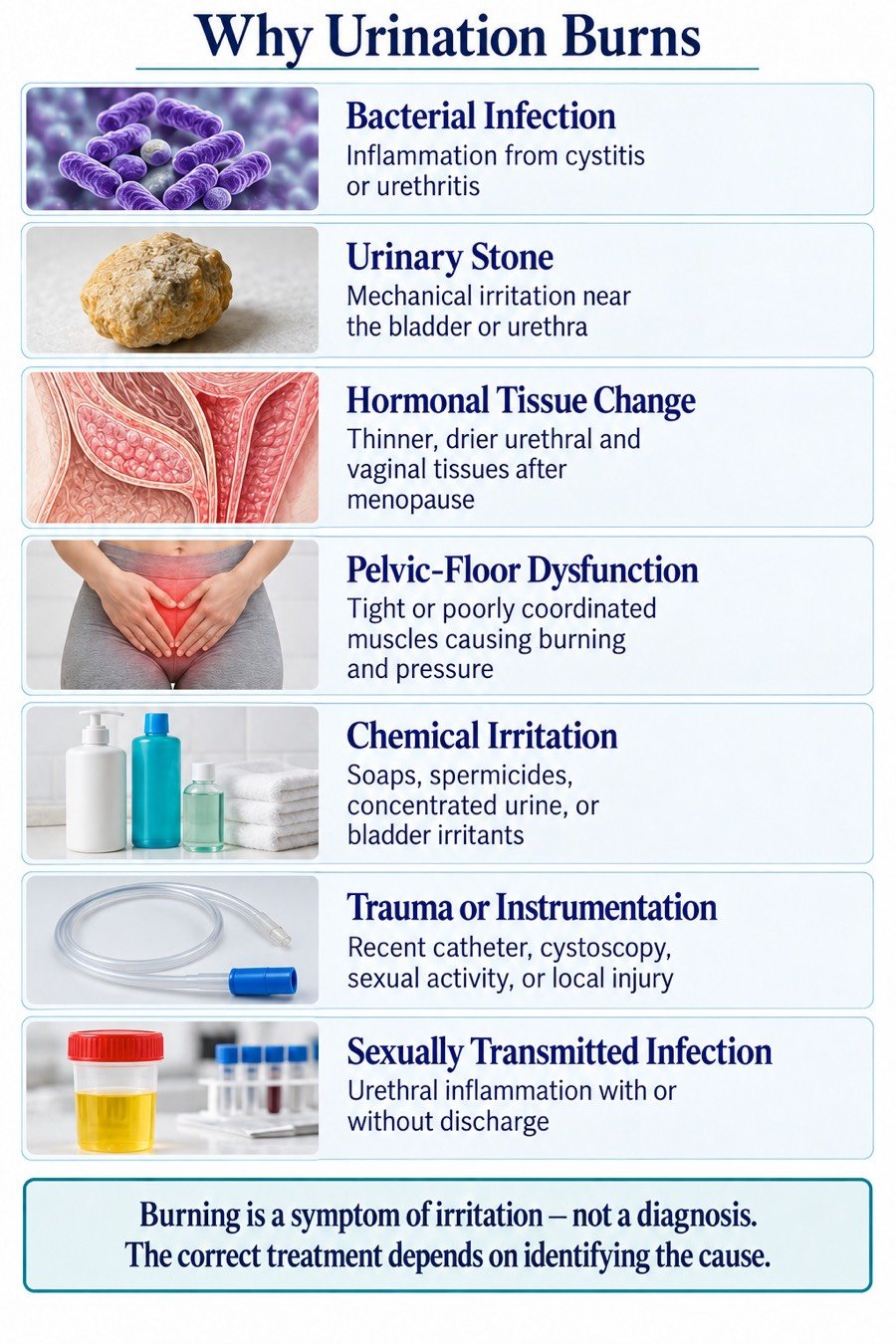
Start with a confidential, specific history
The clinician asks about the symptoms, relevant exposures, the body sites involved, previous results, treatment, medicines and any possibility of pregnancy. This helps select the specimen and test rather than assuming that a routine urine analysis checks for every infection.
Urinary infection, irritation, stones, tissue changes and pelvic-floor symptoms can overlap with STI symptoms. The book’s illustration of painful urination shows why identifying the cause matters before choosing treatment. Pain or burning alone cannot identify a particular organism.
Understand what the result means and what happens next
Different infections may need urine, a site-specific swab, blood testing or examination. A negative result is interpreted in relation to the test, specimen, exposure timing and symptoms; it does not automatically exclude every infection. Ask whether repeat testing or testing at another site is appropriate.
If treatment is needed, the plan should explain how to take it, precautions, when sexual activity can resume, whether partners need evaluation or treatment, and whether a test of cure or later retesting is indicated. Do not share leftover antibiotics or assume symptoms disappearing proves an infection is cleared. Persistent symptoms, a new lesion or a change in the pattern needs reassessment. For a possible recent HIV exposure, seek urgent medical advice because preventive treatment is time-sensitive. Confidential care and clear follow-up are part of the testing process.
Questions to bring to your visit
- Which infections and body sites does this test actually assess?
- Does the timing affect how we interpret a negative result?
- What partner care, treatment precautions or repeat testing will be needed?
When to seek care: Severe pelvic or testicular pain, fever with significant illness, pregnancy with concerning symptoms, or a possible recent HIV exposure needs urgent medical advice. Sudden severe testicular pain requires emergency care.
Explanation adapted from A Urology Consult in a Book by David Shusterman, MD, chapter 9, “Painful Urination.” Original illustration reproduced from the book. CDC: STI testing.
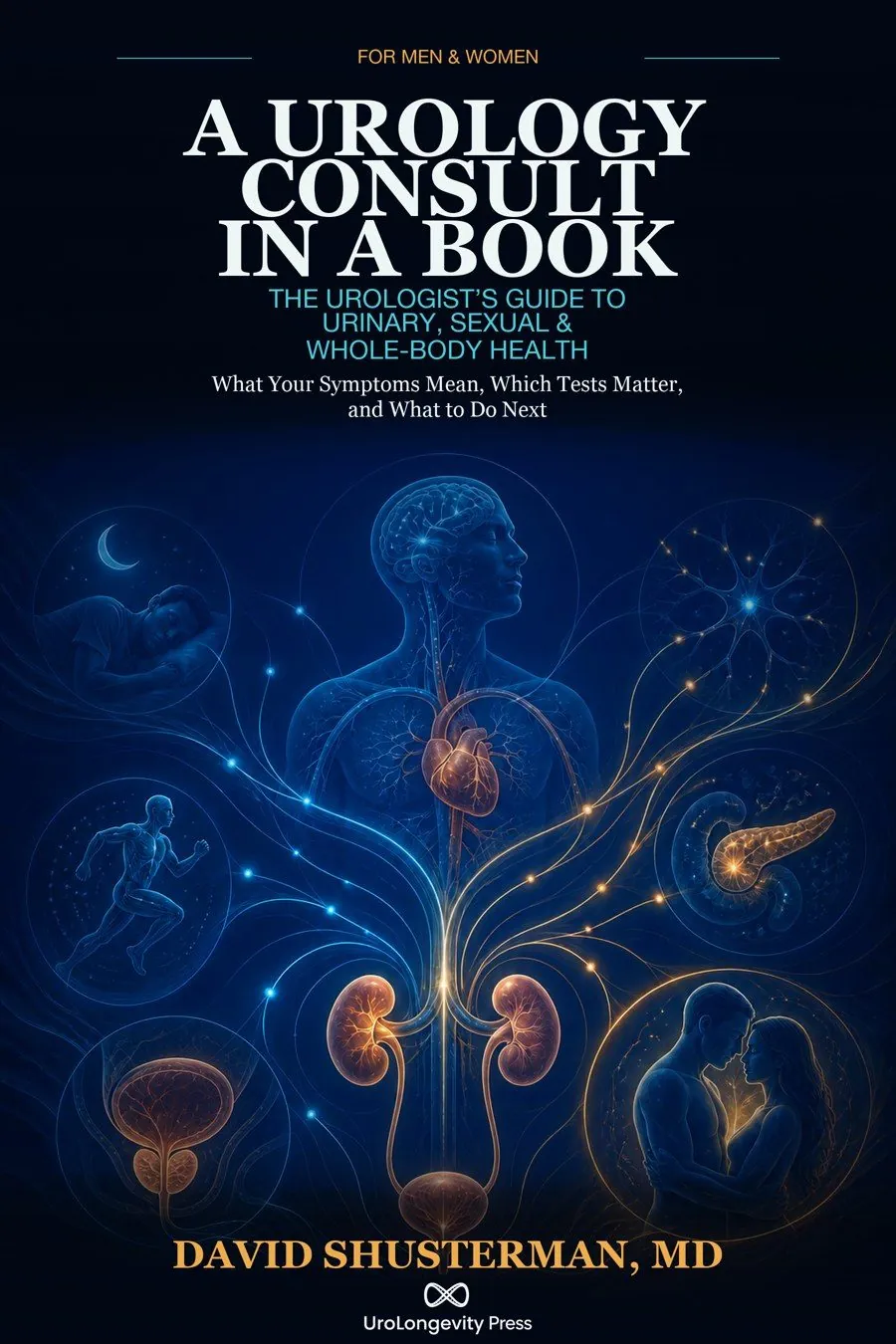
Prepare for your visit with a book by Dr. David Shusterman
A Urology Consult in a Book explains symptoms, evaluation and treatment choices. Bring your questions to your clinician; the book supports that conversation.
Explore the books and care team →Take care of the basics.
Book a men's-health visit at our Manhattan or Forest Hills office — a simple step that's easy to keep putting off.

Manhattan & Queens · All Five Boroughs