
Home · Conditions · Urethral Stricture
Urethral stricture
Urethral Stricture
Explore the illustrated guide ↓
A urethral stricture — scar-tissue narrowing of the urethra — causes a weak stream, straining, and recurring problems. We treat it with Optilume, a state-of-the-art drug-coated balloon shown to outperform standard dilation.
When the urethra narrows
A urethral stricture is a narrowing of the urethra caused by scar tissue. It produces a weak or split stream, straining, incomplete emptying, recurrent urinary tract infections, and — left unchecked — can progress toward retention. The frustration for many men is that standard treatments (simple dilation or internal urethrotomy) often work for a while, then the stricture comes back.
Optilume — a state-of-the-art drug-coated balloon
How it's different
Optilume is a drug-coated balloon (DCB): it gently dilates the stricture and, at the same time, delivers a medication (paclitaxel) to the area that helps keep scar tissue from re-forming. It's a minimally invasive, catheter-based procedure — no open surgery.
The evidence
In the randomized ROBUST III trial, Optilume showed superior freedom from repeat intervention compared with standard endoscopic treatment — a meaningful advantage for men who've had strictures come back after ordinary dilation. For appropriately selected men, it's an excellent way to get durable relief while avoiding, or postponing, open urethral reconstruction (urethroplasty).
Experienced hands
Optilume is newer, advanced technology, and experience with it matters. Dr. Shusterman is among the more experienced physicians offering Optilume for urethral stricture and will give you a straight assessment of whether you're a good candidate.
Strictures in women
Women can develop urethral narrowing too — an under-recognized cause of recurrent UTIs and difficult urination. We evaluate for it and treat with dilation when appropriate.
Why it matters
Done in the office, not the hospital
Because we have a combined urology and interventional radiology team in-office, we diagnose and treat the large majority of what we do right here — see how our in-office model works.
When to see us
If you have a weak stream, straining, recurrent UTIs, or a stricture that keeps coming back after dilation, ask about Optilume. Call (212) 991-9991 or book a consultation.
Common questions
What is Optilume?
Optilume is a drug-coated balloon for urethral stricture. It dilates the narrowing and delivers a medication (paclitaxel) that helps prevent scar tissue from re-forming — a minimally invasive, catheter-based alternative to repeated dilations or open surgery.
Is Optilume better than regular dilation?
In the randomized ROBUST III trial, Optilume showed superior freedom from repeat intervention compared with standard endoscopic treatment. For men whose strictures keep returning after ordinary dilation, that durability is the main advantage.
Does Optilume mean I can avoid surgery?
For appropriately selected men, Optilume can provide durable relief while avoiding or postponing open urethral reconstruction (urethroplasty). Urethroplasty remains the surgical gold standard for some strictures; we'll tell you honestly which path fits your case.
Is it done in the office or hospital?
Optilume is a minimally invasive, catheter-based procedure. We'll review exactly what your treatment involves and what to expect for recovery, which is typically quick.
Can women have urethral strictures?
Yes, though it's less common and under-recognized. Urethral narrowing in women can cause recurrent UTIs and difficult urination, and we treat it with dilation when appropriate.
UNDERSTAND YOUR CARE
A narrow urethra is one possible cause of a weak stream
A urethral stricture is scar-related narrowing of the channel carrying urine out of the body. Weak flow alone cannot establish the diagnosis, because bladder strength and muscle coordination can produce similar symptoms.
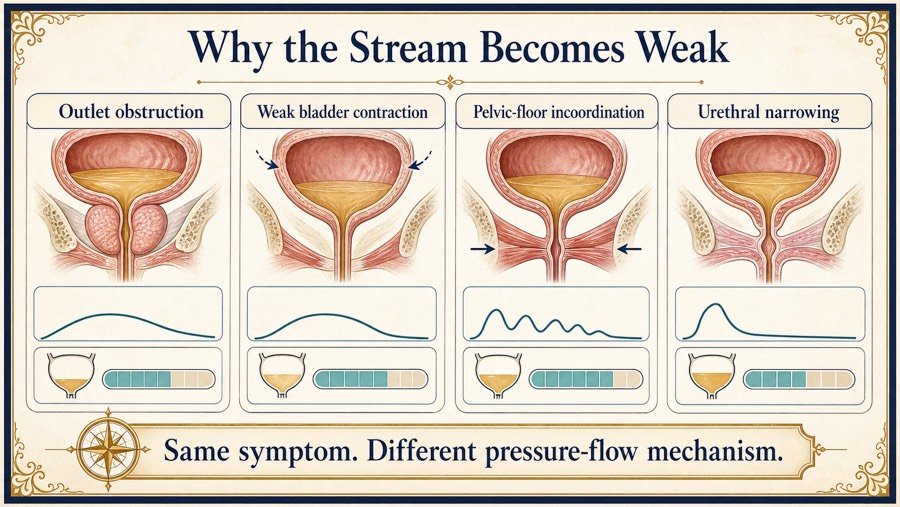
Find where the resistance is coming from
The history may include prior urethral procedures, catheterization, injury, infection, surgery or skin disease, although some patients have no clear triggering event. Symptoms can include a weak or spraying stream, prolonged voiding, straining, incomplete emptying or recurrent infection.
Urine-flow testing and a residual-urine scan provide useful clues but do not define the length and location of a scar. Cystoscopy or dedicated urethral imaging may be needed to establish anatomy when treatment is being planned. The tests should be explained in terms of what they add to the decision.
Discuss the anatomy and the long-term plan
Treatment options depend on the stricture’s location, length, severity, cause and prior procedures. Dilation, internal incision and reconstructive approaches serve different circumstances and have different likelihoods of recurrence. The least extensive procedure is not automatically the most durable option.
Ask whether specialist reconstructive assessment would add value, especially after recurrence or when anatomy is complex. Catheter care, recovery, sexual or urinary effects and follow-up testing should be part of the discussion. A technically open urethra may not correct every symptom if bladder weakness or pelvic-floor dysfunction also contributes. Follow-up looks for both functional improvement and recurrence, with a clear plan for new difficulty passing urine. Do not attempt self-dilation unless a clinician has specifically assessed, prescribed and taught it.
Questions to bring to your visit
- Where is the narrowing and how long is it?
- How do my previous treatments affect the next option?
- What is the recurrence risk and the follow-up plan?
When to seek care: Inability to urinate requires emergency assessment. Fever with poor drainage, severe pain or rapidly worsening urinary symptoms also needs urgent care.
Explanation adapted from A Urology Consult in a Book by David Shusterman, MD, chapter 7, “Weak Stream And Difficulty Urinating.” Original illustration reproduced from the book. EAU: urethral strictures.
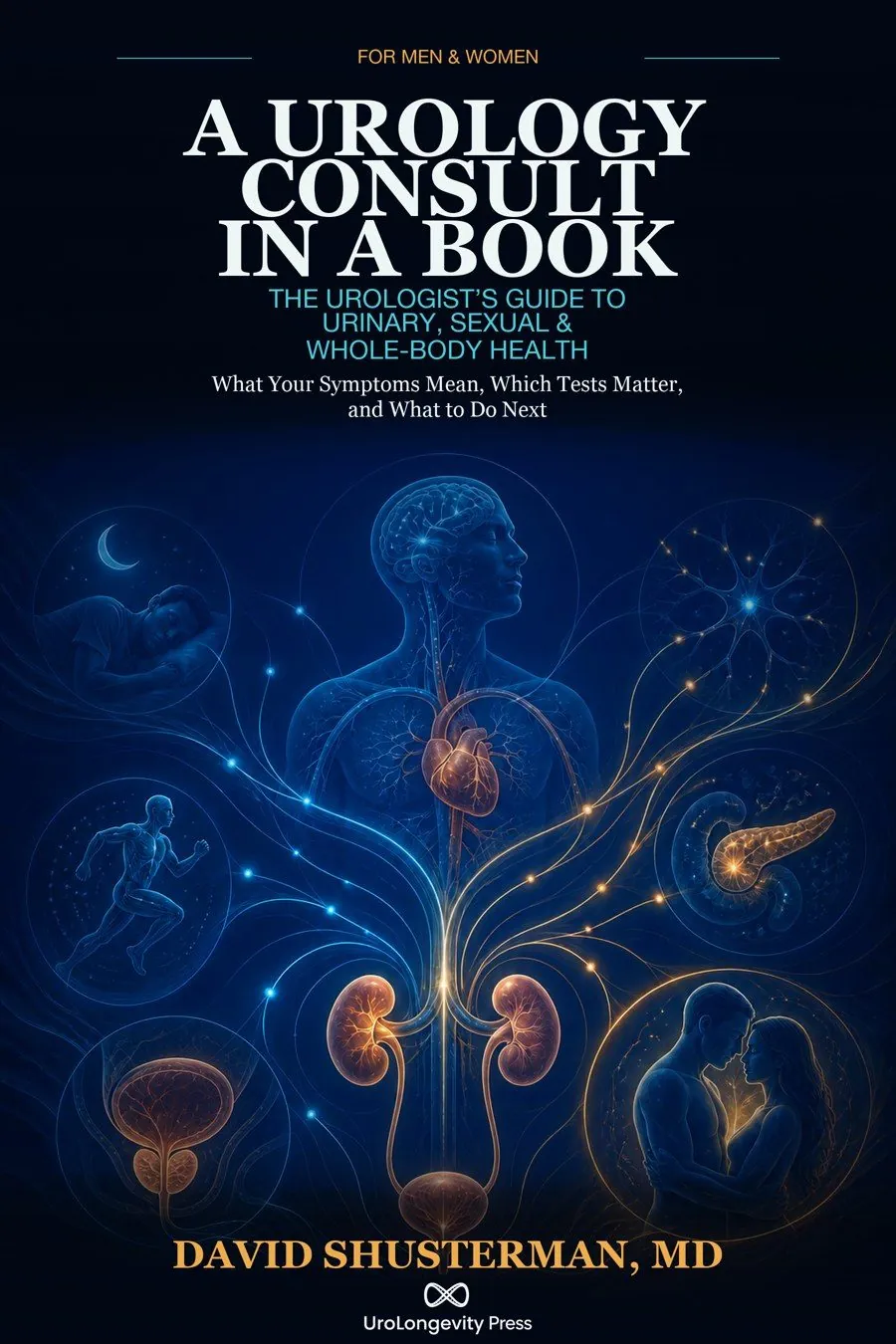
Prepare for your visit with a book by Dr. David Shusterman
A Urology Consult in a Book explains symptoms, evaluation and treatment choices. Bring your questions to your clinician; the book supports that conversation.
Explore the books and care team →Take care of the basics.
Book a men's-health visit at our Manhattan or Forest Hills office — a simple step that's easy to keep putting off.

Manhattan & Queens · All Five Boroughs