
Home · Conditions · Recurrent UTIs
Recurrent UTIs
Recurrent UTIs
Explore the illustrated guide ↓
UTIs that keep coming back have a reason. We start by asking whether it's even an infection, then find the real driver — from the double-hit bladder to urethral narrowing to how the bladder empties — and treat that, so the cycle stops.
Recurring UTIs always have a reason
If you keep getting urinary tract infections, each round of antibiotics treats the episode in front of you but never answers the question that actually matters: why do they keep happening? In my clinical experience, recurrent urinary symptoms almost always have an underlying driver — and finding it is how the cycle finally breaks. (For a single, uncomplicated infection, see our UTI treatment page.)
First — is it even an infection?
Patients use the word "UTI" for burning, urgency, and frequency, but not every episode is an infection. Many recurring flares may be inflammation rather than infection — an overactive bladder, chronic cystitis, pelvic-floor tension, or, after menopause, thinning of the tissue (genitourinary syndrome of menopause) that leaves the bladder more vulnerable. These mimics can feel identical to an infection, but they call for very different treatment. Sorting infection from inflammation is the first fork in the road, and it changes everything that follows.
The double-hit bladder
A UTI in an otherwise healthy bladder is a different problem from a UTI landing on tissue that is already inflamed, sensitized, or not emptying well. Bacteria may start the event, but much of the burning, urgency, and pain comes from the bladder's own inflammatory response. When infection stacks on top of an already-irritated lining — what I think of as the double-hit bladder — an occasional infection can turn into a recurrent, life-disrupting pattern. Calming the lining can matter as much as clearing the bacteria.
Diagnosis before more antibiotics
This is not anti-antibiotic — a real bacterial infection deserves prompt, appropriate treatment. But complex, recurring symptoms deserve a diagnosis before another reflex prescription. In recurrent cases a single culture is a clue; the pattern across several cultures over time often tells the real story. In our office, ultrasound is a practical extension of the exam — not a rare hospital test — so we can see how the bladder empties, check for retention, stones, or wall changes, and measure urine flow on the same visit. (Uroflow isn't just a men's test — women have voiding mechanics too.)
Causes we specifically look for
Urethral narrowing in women
An under-recognized driver of recurrent UTIs in women is urethral narrowing or stenosis, which can keep the bladder from emptying completely and let bacteria persist. Many practices never check for it. When we find it, urethral dilation can make a real difference.
How the bladder empties
Urodynamic testing measures how the bladder fills, holds, and empties, and can reveal incomplete emptying, obstruction, or bladder-function problems behind recurring infections — turning "bad luck" into something we can actually target. In men, we also look for incomplete emptying from prostate obstruction.
The rest of the work-up
We evaluate for other contributors — stones acting as a bacterial reservoir, anatomical factors, tissue health, and voiding habits — and build prevention around what we actually find, rather than relying on endless antibiotic courses. Blood in the urine changes the clinical question and always earns its own look.
Why it matters
Done in the office, not the hospital
Because we have a combined urology and interventional radiology team in-office, we diagnose and treat the large majority of what we do right here — see how our in-office model works.
When to see us
If you've had multiple UTIs in a year, or infections that keep returning after treatment, it's time to find out why. Call (212) 991-9991 or book a consultation.
Common questions
Could my recurring "UTIs" not be infections at all?
Yes — this is one of the most important questions to ask. Burning, urgency, and frequency can come from inflammation rather than infection: overactive bladder, chronic cystitis, pelvic-floor tension, or menopausal tissue changes. They can feel identical to a UTI but need very different treatment, which is why we sort infection from inflammation first.
Why do I keep getting UTIs?
When the episodes truly are infections, there's usually an underlying driver — incomplete bladder emptying, urethral narrowing (especially in women), obstruction, stones, or a bladder lining that's already irritated. Finding and treating that driver is how the cycle breaks, rather than repeated antibiotics alone.
What is the "double-hit bladder"?
A UTI on a healthy bladder is different from a UTI landing on tissue that's already inflamed or not emptying well. Bacteria start the event, but much of the suffering comes from the bladder's own inflammation. When infection stacks on an already-irritated lining, occasional infections can become a recurrent pattern — so we treat both the bacteria and the lining.
Why do you use ultrasound and check how I empty?
In our office, ultrasound is a practical extension of the exam, not a rare hospital test. It lets us see how the bladder empties and check for retention, stones, or wall changes on the same visit. We also measure urine flow — and yes, that applies to women too, not just men — because how the bladder empties is often part of why infections recur.
Can recurrent UTIs be prevented without constant antibiotics?
Often, yes — by identifying and treating the underlying cause. This isn't anti-antibiotic; a real infection still deserves proper treatment. But we build prevention around what the evaluation actually shows rather than relying on endless antibiotic courses.
How many UTIs count as "recurrent"?
Generally, multiple infections within a year — or infections that keep returning after treatment — warrant a deeper evaluation to find the underlying cause.
UNDERSTAND YOUR CARE
Turn repeated UTI episodes into a useful pattern
Repeated urinary symptoms deserve a record-based evaluation. The first question is whether the episodes were confirmed infections, rather than assuming every episode of burning had the same cause.
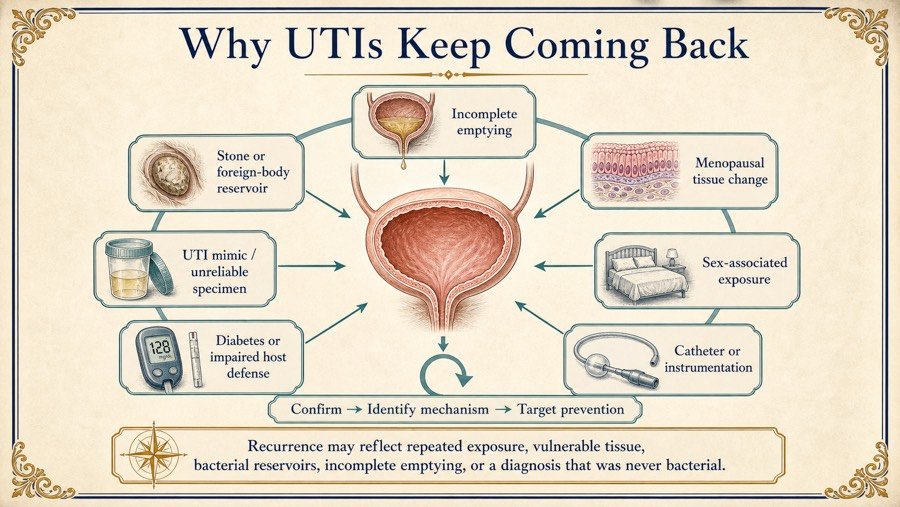
Bring the evidence from separate episodes together
Dates, symptoms, cultures, antibiotics and response are more helpful than a list of prescriptions alone. The timing between episodes and whether the same organism recurs can help distinguish reinfection, relapse or an unresolved source. A culture result is interpreted with symptoms and collection quality.
The review may consider incomplete emptying, stones, sexual or contraceptive exposures, menopausal tissue changes, bowel issues and relevant medical conditions. Imaging or cystoscopy is selected when the history suggests a reason; not everyone with recurrent uncomplicated infection needs an extensive invasive work-up.
Choose prevention for the actual contributor
Prevention may involve changes to an identified exposure, an appropriate hydration strategy, treatment of tissue changes or another underlying problem. In eligible peri- or postmenopausal patients, local vaginal estrogen may be part of the discussion. Selected non-antibiotic or antibiotic prevention strategies have different evidence, precautions and monitoring needs.
The best plan also says what to do during the next episode: when to obtain a urine sample, whom to contact, what symptoms require urgent care and how treatment will be adjusted to results. If pain or frequency continues between infections, that pattern may require its own diagnosis. Success means fewer clinically meaningful infections and less unnecessary treatment, not simply keeping every urine test sterile. Review the prevention plan after a defined interval and reconsider it when the pattern changes.
Questions to bring to your visit
- Which previous episodes were culture-supported infections?
- Is there a reversible contributor such as retention, a stone or tissue change?
- What is my plan for testing and contacting the office when symptoms return?
When to seek care: Fever, flank pain, vomiting or systemic illness needs urgent assessment. Do not wait for a routine recurrent-UTI appointment when a current episode is severe or worsening.
Explanation adapted from A Urology Consult in a Book by David Shusterman, MD, chapter 14, “Recurrent Urinary Infections.” Original illustration reproduced from the book. EAU: urological infections guidance.

Prepare for your visit with a book by Dr. David Shusterman
A Urology Consult in a Book explains symptoms, evaluation and treatment choices. Bring your questions to your clinician; the book supports that conversation.
Explore the books and care team →Take care of the basics.
Book a men's-health visit at our Manhattan or Forest Hills office — a simple step that's easy to keep putting off.

Manhattan & Queens · All Five Boroughs