
Home · Conditions · Urinary Tract Infections
Stones & urinary
Urinary Tract Infections (UTIs)
Explore the illustrated guide ↓
UTIs are common and usually simple to treat — but a UTI is more than bacteria in urine. We treat fast with same-day testing, and treat the first one as a window to prevent the next.
See it illustrated
Explore selected illustrations, then open a guide to see the full image and related reading.
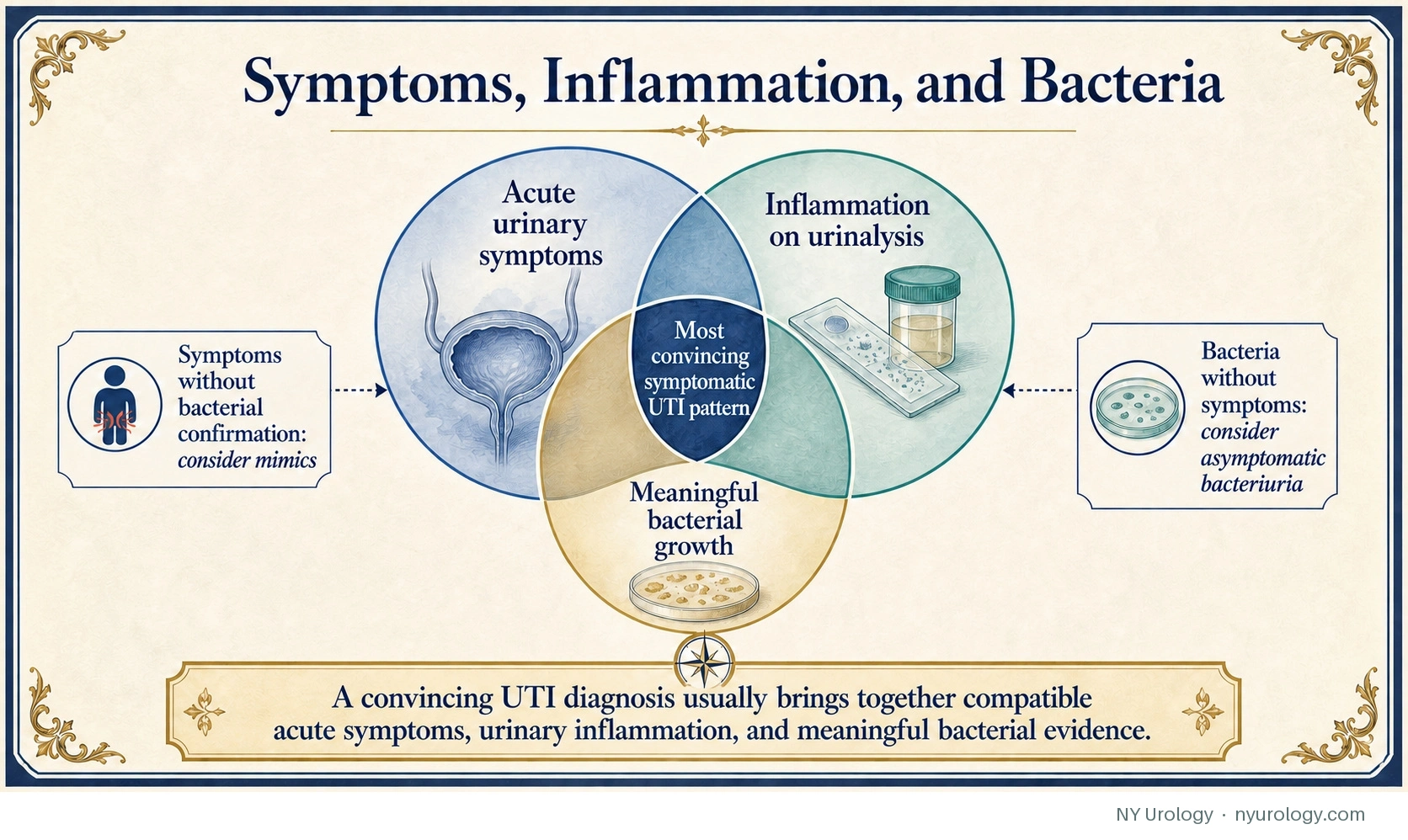
Symptoms, Inflammation, and Bacteria
Open illustrated guide →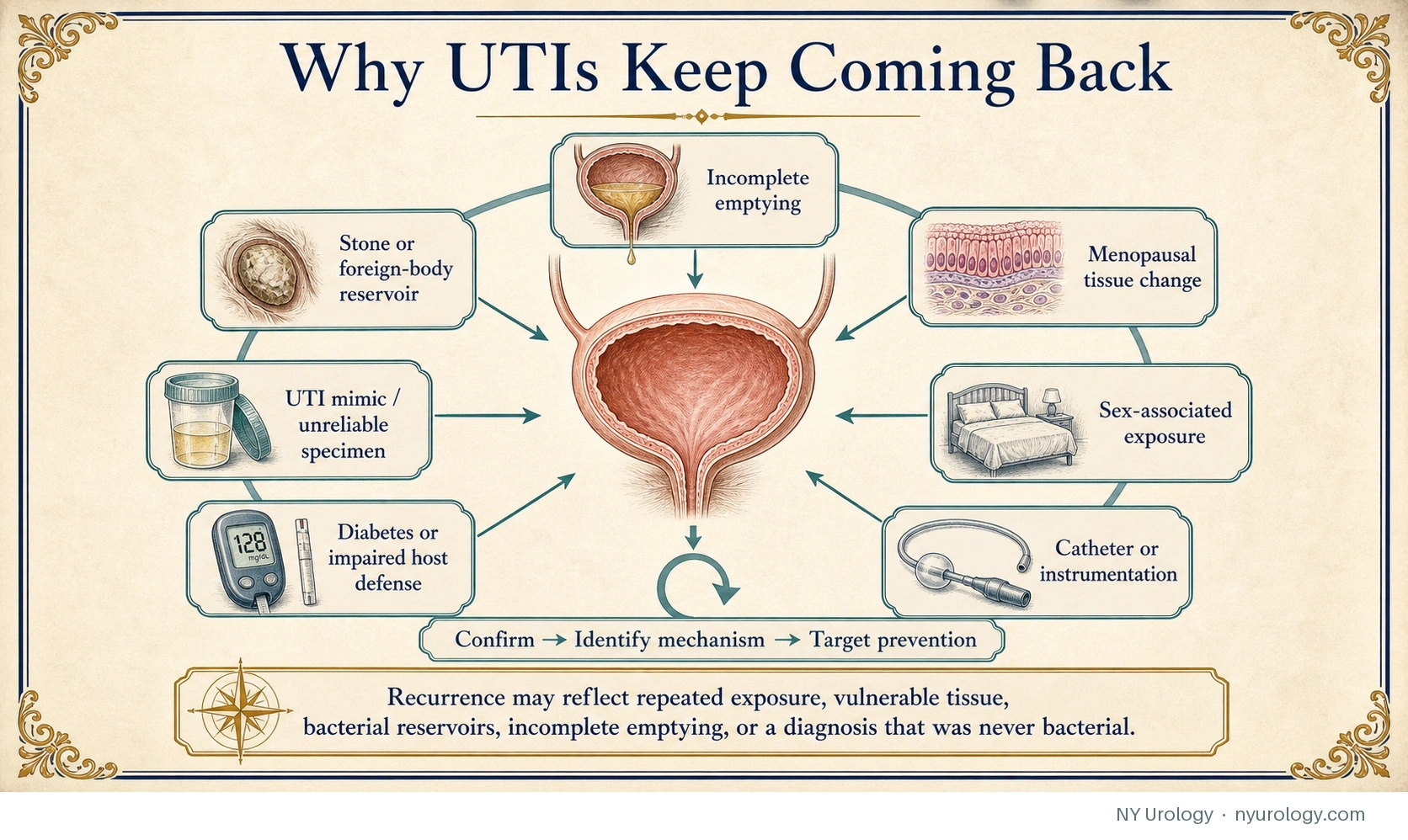
Why UTIs Keep Coming Back
Open illustrated guide →UTIs — treated quickly, and understood properly
Urinary tract infections are common and usually straightforward to treat. But a UTI is more than bacteria floating in urine — a true infection means bacteria are interacting with the bladder lining, and that interaction is where a urologist's perspective helps, whether it's your first infection or your fifth.
What's actually happening
Bacteria may start the event, but in my clinical experience much of what you feel — the burning, urgency, and frequency — comes from the bladder's own inflammatory response, not the bacteria alone. The bladder lining is living tissue, and an infection irritates it; after the bacteria are cleared, that lining still needs a short healing window before it fully settles. Understanding that is why some people feel "not quite right" for a few days even after appropriate treatment — and why the goal is to calm the bladder, not just kill the bug.
The first UTI is a prevention window
A first UTI may resolve and never return. But it's also the ideal moment to get ahead of the problem — to look at how you void, your hydration, tissue health, and bladder emptying — before a recurrent cycle ever takes hold. Most care starts only after the burning does; we'd rather teach prevention while the bladder is still healthy. If infections have already become a pattern, that's a different, deeper conversation — see recurrent UTIs.
Symptoms
- Burning with urination
- Frequent, urgent need to go
- Cloudy urine
- Pelvic or lower-abdomen discomfort
- Blood in the urine
- Fever or back pain (more serious)
Two clarifications worth knowing: odor alone is not infection — urine smell often just reflects diet, vitamins, medications, or dehydration. But blood in the urine is different and always earns its own look, even when a UTI seems the obvious explanation. And fever, chills, or back pain can mean the infection has reached the kidney — that deserves prompt attention.
Same-day testing — and treating the real thing
We offer rapid, same-day in-office testing so treatment starts fast. This isn't anti-antibiotic — a true bacterial infection deserves prompt, appropriate treatment. What we avoid is treating by assumption: a culture, interpreted clinically, makes sure we're treating an infection that's actually there rather than something wearing a UTI's clothing.
When to come in
Book a visit for a first infection you want to get ahead of, symptoms that won't clear, recurrent infections, or any UTI with fever, back pain, or blood. We'll sort it at our Manhattan or Forest Hills office.
Common questions
What are the symptoms of a UTI?
Common signs include burning with urination, needing to go often or urgently, cloudy or strong-smelling urine, and pelvic discomfort. Blood in the urine can also occur.
When should I see a urologist for a UTI?
See a specialist if UTIs keep coming back, don't clear with treatment, or come with fever, back pain, or blood — which can signal a kidney infection or another underlying issue worth investigating.
Why do I keep getting UTIs?
Recurrent UTIs can have several causes — anatomy, incomplete emptying, or other factors. We can run a workup to find the reason rather than just treating each episode.
Can you test for a UTI same-day?
Yes — we offer same-day, in-office testing so treatment can start quickly rather than waiting on outside labs.
Is strong-smelling urine a sign of a UTI?
Not by itself. Urine odor often just reflects diet, vitamins, medications, or dehydration — asparagus and B vitamins are common culprits. Odor alone is a weak signal; burning, urgency, and frequency (ideally confirmed by testing) matter far more. Blood in the urine, on the other hand, always deserves evaluation.
Why do I still feel off after antibiotics cleared the infection?
Because a UTI irritates the bladder lining, and that tissue needs a short healing window even after the bacteria are gone. Much of the discomfort of a UTI comes from inflammation, not just the bacteria, so it can take a little time for the bladder to fully settle. If symptoms persist or keep returning, that's worth a closer look.

UTI Unlocked by David Shusterman, MD. Explore the author’s books as you prepare questions for your appointment.
Related care
You might also look at
UNDERSTAND YOUR CARE
When urinary symptoms point to infection—and when they do not
Burning and frequent urination can occur with a bladder infection, but symptoms alone do not identify the cause. The most useful diagnosis brings the symptom pattern together with appropriate urine evidence.

A sample is part of the clinical picture
A clinician considers when symptoms began, whether there is fever or flank pain, pregnancy status, previous infections, medicines and other health conditions. Urinalysis looks for findings such as inflammation; culture can help identify bacteria and guide treatment when indicated. Collection and handling affect how results should be interpreted.
A positive culture without compatible symptoms is a different situation from a symptomatic infection. Contamination can also complicate interpretation. Antibiotics are not automatically appropriate for every abnormal urine report, and exceptions such as pregnancy or certain urologic procedures require an individualized clinical plan.
Reassess when the story does not fit
Vaginal or urethral irritation, sexually transmitted infection, menopausal tissue changes, stones, pelvic-floor dysfunction and bladder pain can produce overlapping symptoms. Persistent symptoms after treatment should prompt a fresh assessment rather than repeated antibiotics without checking the explanation.
If antibiotics are prescribed, the choice and duration depend on the infection context, prior culture information, allergies, kidney function and other considerations. Do not start leftover antibiotics or share someone else’s prescription. Ask how you will receive culture results and whether the plan could change when they return. If symptoms recur, keep the dates, actual culture reports and treatments together. A record of what improved—and what did not—helps distinguish a new infection, relapse, an unresolved contributor or a different diagnosis.
Questions to bring to your visit
- What evidence supports a bacterial infection in this episode?
- Is a culture needed, and how will results change treatment?
- What should we investigate if symptoms persist despite treatment?
When to seek care: Fever, chills, flank pain, persistent vomiting, marked weakness or worsening illness can signal infection beyond the bladder. Seek urgent care, particularly with pregnancy or suspected obstruction.
Explanation adapted from A Urology Consult in a Book by David Shusterman, MD, chapter 13, “Urinary Tract Infection Or Something Else?.” Original illustration reproduced from the book. NIDDK: bladder infection in adults.
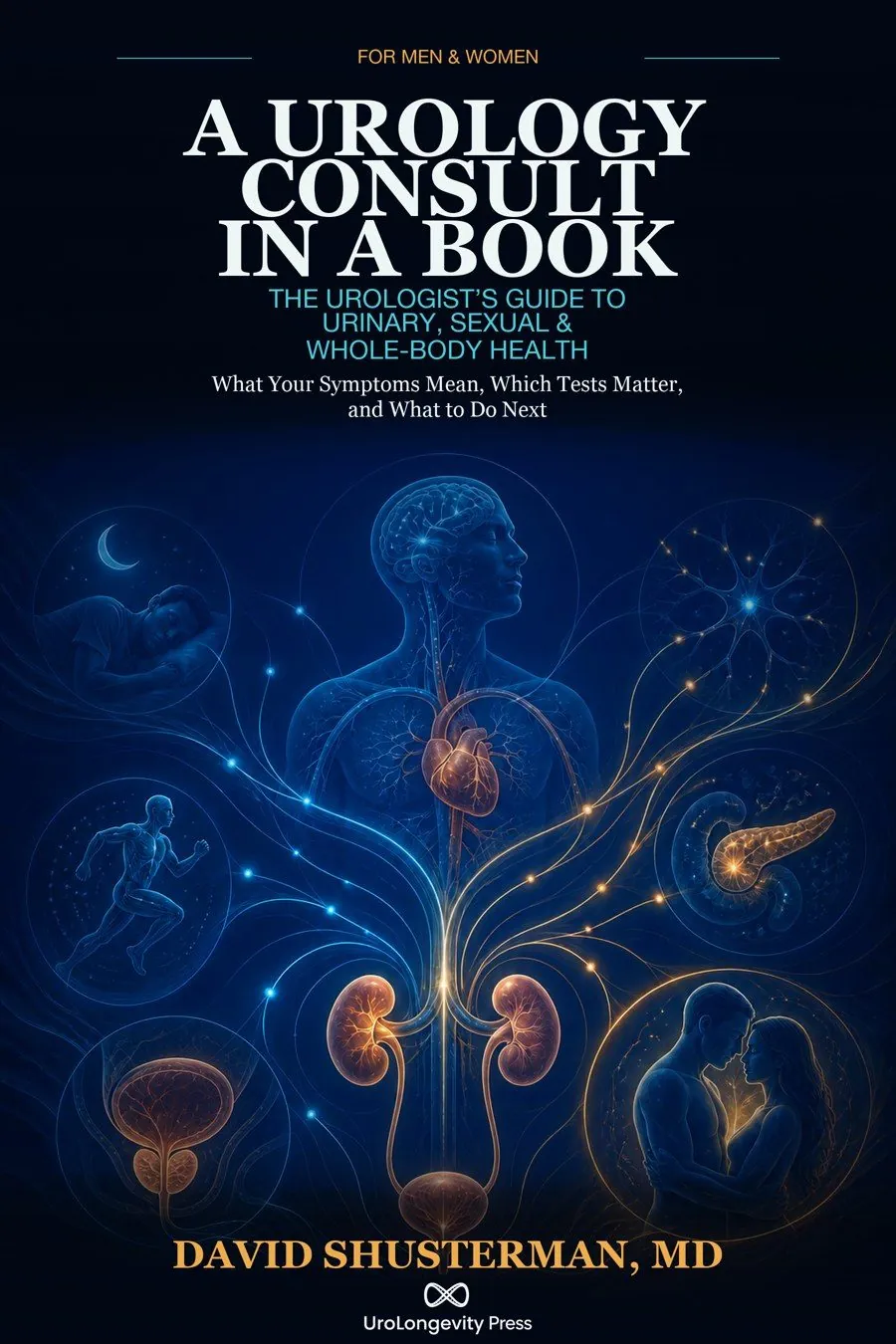
Prepare for your visit with a book by Dr. David Shusterman
A Urology Consult in a Book explains symptoms, evaluation and treatment choices. Bring your questions to your clinician; the book supports that conversation.
Explore the books and care team →Stuck with UTIs?
Book at our Manhattan or Forest Hills office — same-day testing and a plan to stop them recurring.

Manhattan & Queens · All Five Boroughs