
Pelvic health explained · English edition
A reassuring test result can be welcome and frustrating at the same time. You may be relieved that a particular problem was not found, yet still be unable to sit comfortably, sleep well or use the bathroom without pain.
“Normal” is meaningful only in relation to the question a test was designed to answer. It should help guide the evaluation, not end the conversation about continuing symptoms.
Start with the question each test answered
A urine test, an ultrasound and an examination do different jobs. Ask your clinician which conditions a result makes less likely, whether its timing affects the interpretation and what it cannot assess.
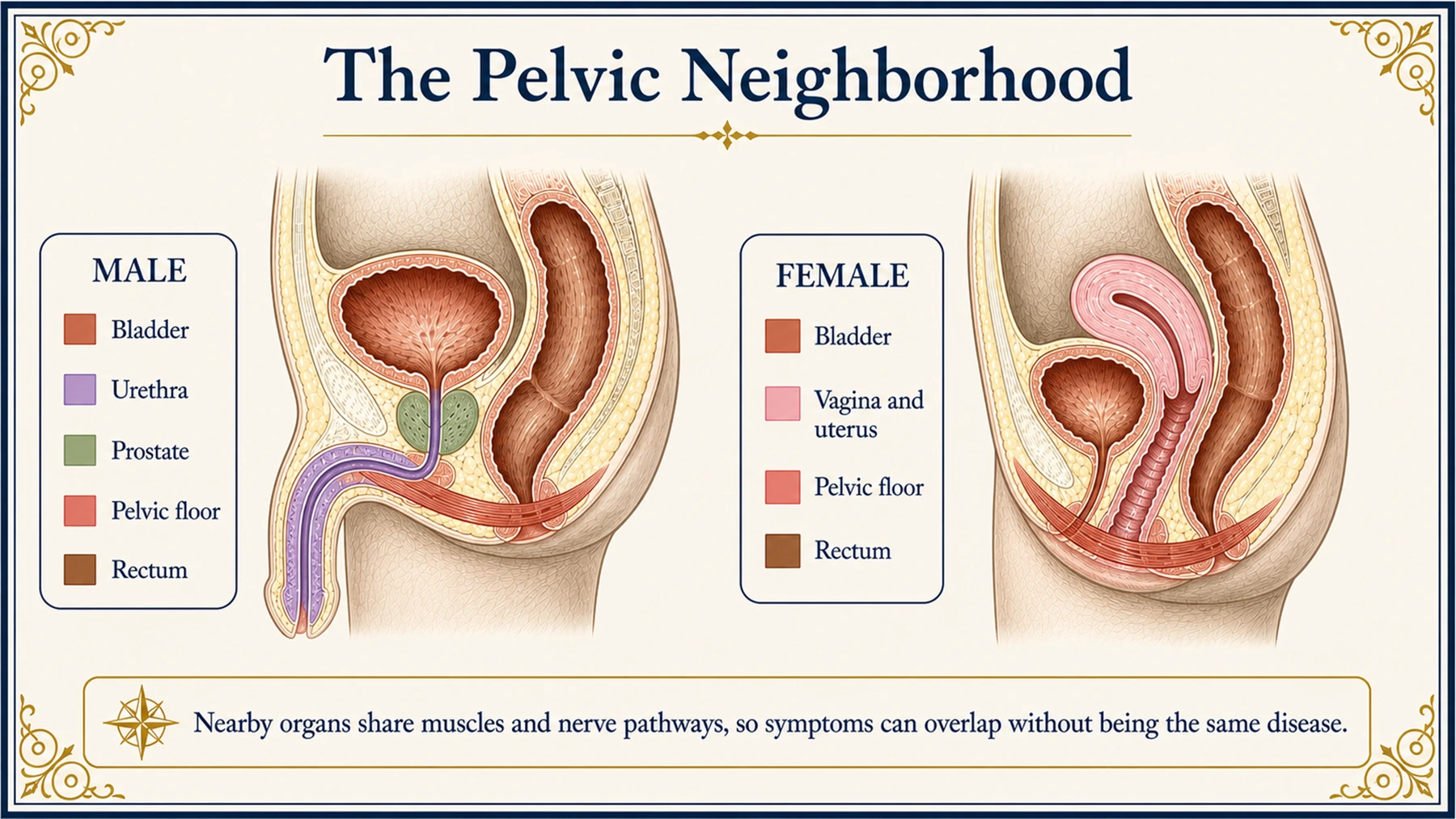
For example, a test that provides information about urinary tract anatomy does not fully describe how the pelvic-floor muscles relax during everyday activities. A reassuring result is not proof that every possible contributor has been excluded.
A teaching example: results without a clear explanation
The following is adapted from a fictionalized composite in Inside the Fire, not a real patient testimonial.
A person develops pelvic burning after travel and receives treatment. Later, frequency, discomfort after ejaculation and a feeling of incomplete emptying become part of the picture. Several results are reassuring, but the person still does not know what is being considered or why.
The next useful step is to organize the timeline and ask focused questions. How were infection and emptying assessed? Were there warning signs? Does the examination suggest a muscular contributor? What finding would change the plan?
The lesson is not that a particular test or diagnosis was missed. It is that results need an explanation the patient can understand.
Persistent pain deserves a focused reassessment
Your clinician may ask about the relationship between pain and bladder filling, urination, sitting, bowel movements, exercise or sexual activity. The location and timing of symptoms can help organize the possibilities. They do not establish a diagnosis on their own.
Depending on the pattern, the evaluation may include examination, review of cultures, an assessment of bladder emptying or other selected tests. Pelvic-floor, bladder, bowel and other conditions can overlap. No single checklist is appropriate for everyone.
An internal examination should have a stated purpose and your consent. You can ask what it involves, what alternatives exist and whether it can be stopped or deferred.
A treatment plan can acknowledge uncertainty
It is reasonable to ask for the leading explanation, the alternatives still being considered and the reason for the proposed next step. A working diagnosis can change when new information appears.
A useful plan also names the symptom or function being addressed. Better sleep, less urgency or a longer comfortable sitting period can matter even before every question is resolved. Tracking should be simple enough to use and should help with a real decision.
Avoid interpreting every good day as proof of a cure or every flare as proof that the diagnosis was wrong. Bring the pattern to the follow-up visit so treatment can be reconsidered in context.
Know when a new symptom changes the plan
A previous normal result does not make new fever, inability to urinate, heavy urinary bleeding or severe worsening pain safe to ignore. Seek urgent assessment for these changes. Sudden severe testicular pain needs emergency care.
Prepare for the next appointment
Bring a short timeline, original reports when available and your main unanswered question. NY Urology offers appointments in Manhattan and Forest Hills. You do not need a perfect symptom diary to begin a conversation about persistent pelvic pain.
Related reading and care
- Prostatitis evaluation and treatment
- The pelvic-pain network, illustrated
- Prostatitis and chronic pelvic-pain guide
- Prostatitis keeps coming back after antibiotics: what should be reassessed?
- Pelvic-floor pain: why more Kegels may be the wrong starting point
- Your first prostatitis visit: bring a timeline, leave with a plan
- A pelvic-pain flare plan: familiar symptoms or something new?
Sources and further reading
Adapted from Inside the Fire, by David Shusterman, MD. Practice editorial edition, October 29, 2026. These explanations support a conversation with your clinician; they do not diagnose your symptoms.