
Home · Conditions · Urinary Retention
Urinary retention
Urinary Retention
Explore the illustrated guide ↓
Urinary retention — being unable to empty the bladder — is often the end stage of an enlarged prostate left untreated too long. Our approach is to treat earlier, so fewer men ever reach that point.
What urinary retention is
Urinary retention means the bladder can't empty properly — partially (chronic) or completely (acute). Acute, complete retention is painful and a medical emergency that needs prompt bladder drainage. Chronic retention develops quietly and can damage the bladder and kidneys over time.
The cause is usually a prostate problem caught too late
In men, retention most often comes from an enlarged prostate (BPH) that has gradually obstructed the flow. Many practices wait — managing symptoms with medication — until the bladder finally fails and retention forces a surgical procedure. We take a different view.
Treat earlier — often without surgery
Don't wait for the bladder to fail
Treating significant prostate obstruction earlier may help preserve bladder function and reduce the risk of progressing to retention. We'd rather intervene before the bladder is damaged than wait for a crisis.
PAE — a non-surgical option
One reason we can treat earlier is prostate artery embolization (PAE) — a minimally invasive, non-surgical procedure that shrinks the prostate's blood supply to relieve obstruction. It's well tolerated and doesn't carry the same threshold as major surgery, so it's a reasonable option earlier in the process. Dr. Shusterman performs PAE through our dedicated prostate center, with over 1,000 procedures since 2021.
If you're already in retention
If you've had an episode of retention or are using a catheter, we can evaluate the cause, relieve the obstruction, and work toward getting you catheter-free with the least invasive approach that fits.
Why it matters
Done in the office, not the hospital
Because we have a combined urology and interventional radiology team in-office, we diagnose and treat the large majority of what we do right here — see how our in-office model works.
When to see us
If you're straining, emptying poorly, getting up repeatedly at night, or have had a retention episode, don't wait for it to worsen. Call (212) 991-9991 or book a consultation. Sudden, complete inability to urinate is an emergency — seek immediate care.
Common questions
What causes urinary retention in men?
Most often an enlarged prostate (BPH) that has gradually obstructed urine flow. Other causes include urethral stricture, nerve issues, and certain medications. We evaluate to find the specific cause.
Can urinary retention be prevented?
Often it can be reduced or delayed by treating significant prostate obstruction earlier, rather than waiting until the bladder fails. Earlier treatment may help preserve bladder function — that's central to our approach.
How does PAE help?
Prostate artery embolization is a minimally invasive, non-surgical procedure that shrinks the prostate's blood supply to relieve obstruction. Because it's well tolerated, it can be a reasonable option earlier in the process, before retention develops.
Is acute urinary retention an emergency?
Yes. Sudden, complete inability to urinate is painful and requires prompt bladder drainage — seek immediate care. We can then evaluate the cause and plan treatment to prevent it from recurring.
I'm using a catheter — can I get off it?
Often, yes. We evaluate why retention happened, relieve the underlying obstruction, and work toward getting you catheter-free using the least invasive approach that fits your situation.
UNDERSTAND YOUR CARE
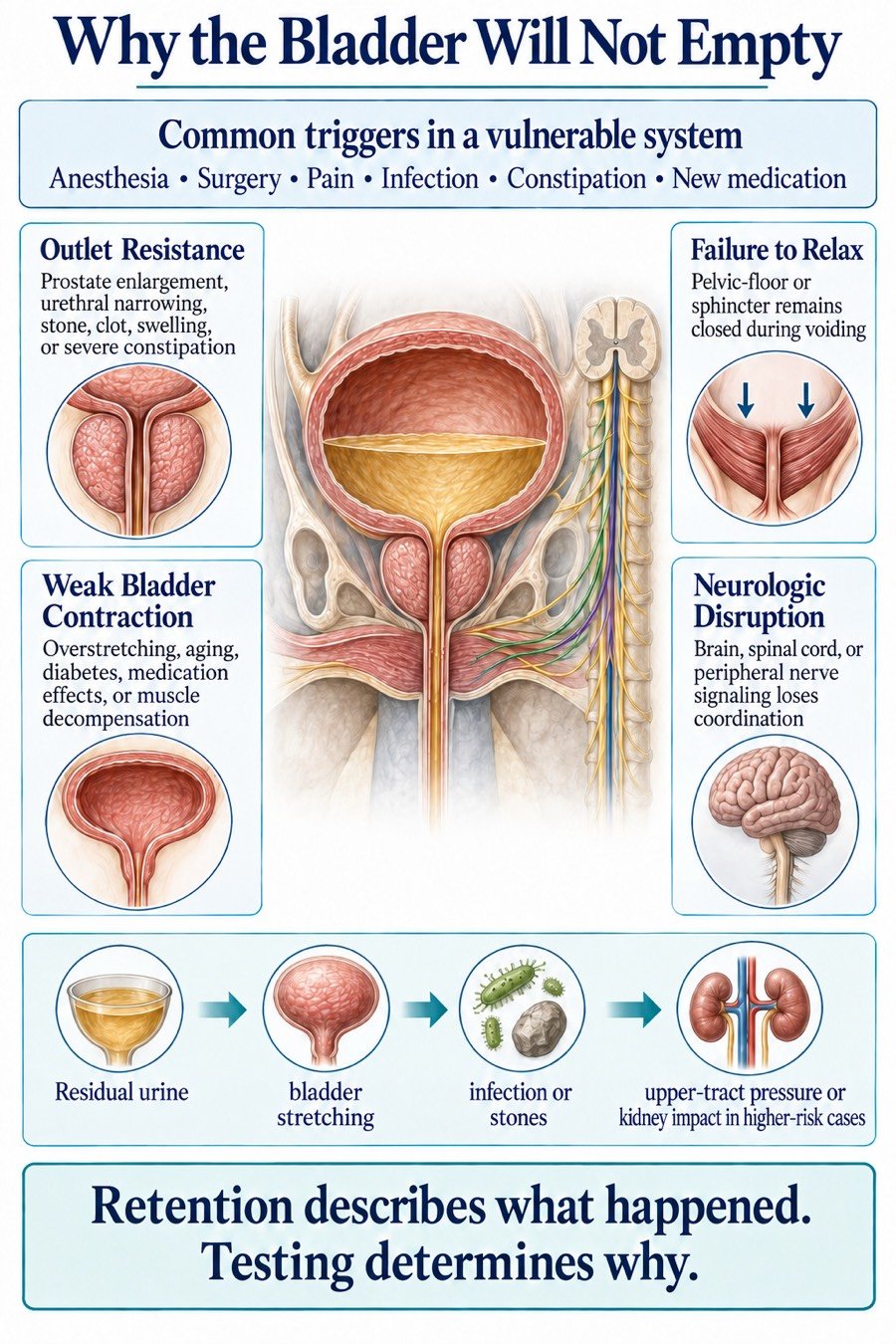
Retention describes the result; testing finds the cause
Passing a little urine does not prove the bladder is empty. Some people develop painful sudden retention, while others gradually retain urine with surprisingly little discomfort.
Separate an emergency from chronic incomplete emptying
A sudden inability to urinate, often with lower abdominal pressure or pain, needs prompt emergency assessment and may require drainage before the full cause is known. Drinking extra water to force urine through does not correct a blocked outlet.
Chronic retention may appear as weak flow, repeated small voids, dribbling or leakage from an overfilled bladder. Its significance depends on symptoms and complications as well as the measured residual. Kidney function, upper-tract dilation, recurrent infection and bladder stones can change how quickly the situation needs attention.
Look beyond a single bladder-scan number
The bladder acts as a pump working against an outlet. Prostate enlargement or urethral narrowing may create resistance; a weak bladder contraction, an unrelaxed pelvic floor or disrupted nerve signals may also interfere with emptying. Surgery, anesthesia, constipation, infection and medicines can trigger retention in a vulnerable system.
A bladder scan tells us how much urine remained after that particular void. It cannot by itself distinguish obstruction from weak contraction. History, examination, medication review, urine testing, kidney assessment and sometimes flow or pressure testing help explain the mechanism. Treatment may involve a drainage strategy, adjustment of contributing factors, medication or a procedure selected for the actual cause. If a catheter is needed, ask how it will be managed, when reassessment occurs and what finding will determine the next step.
Questions to bring to your visit
- What is causing the emptying problem, and are my kidneys affected?
- Is this residual measurement representative or should it be repeated?
- What is the catheter or drainage plan, and when will we reassess it?
When to seek care: Go to emergency care if you cannot urinate. New leg weakness, saddle-area numbness or loss of bowel control with urinary changes also requires emergency assessment.
Explanation adapted from A Urology Consult in a Book by David Shusterman, MD, chapter 11, “Urinary Retention.” Original illustration reproduced from the book. NIDDK: urinary retention.

Prepare for your visit with a book by Dr. David Shusterman
A Urology Consult in a Book explains symptoms, evaluation and treatment choices. Bring your questions to your clinician; the book supports that conversation.
Explore the books and care team →Take care of the basics.
Book a men's-health visit at our Manhattan or Forest Hills office — a simple step that's easy to keep putting off.

Manhattan & Queens · All Five Boroughs