
Patient education · English edition · October 29, 2026
BPH: choose your next step
A practical comparison of enlarged-prostate treatments.
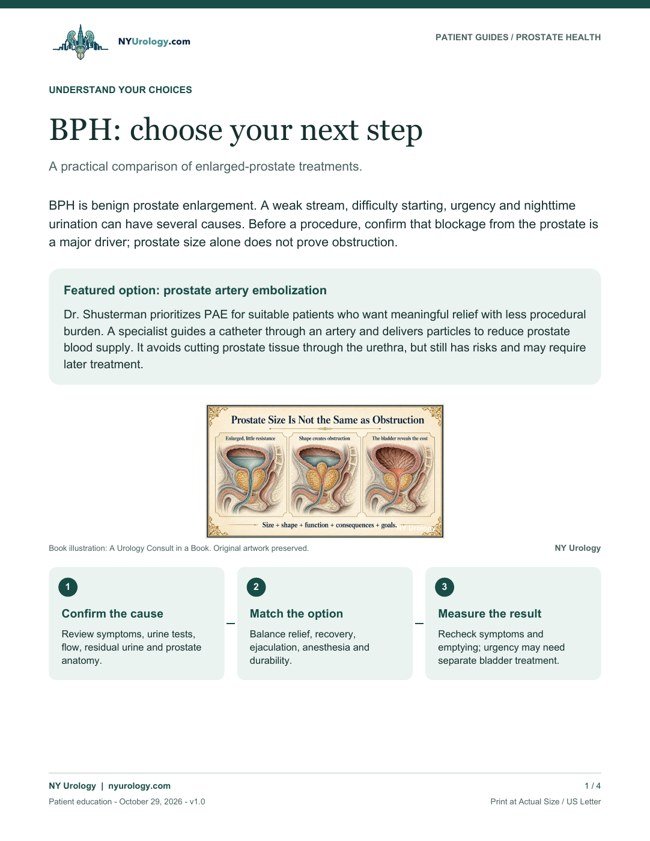
BPH is benign prostate enlargement. A weak stream, difficulty starting, urgency and nighttime urination can have several causes. Before a procedure, confirm that blockage from the prostate is a major driver; prostate size alone does not prove obstruction.
Featured option: prostate artery embolization
Dr. Shusterman prioritizes PAE for suitable patients who want meaningful relief with less procedural burden. A specialist guides a catheter through an artery and delivers particles to reduce prostate blood supply. It avoids cutting prostate tissue through the urethra, but still has risks and may require later treatment.
Compare the options
| Option | Why consider it | What to weigh |
|---|---|---|
| PAE | Minimally invasive arterial treatment; often uses local anesthesia with sedation. Especially relevant for larger glands. | Urologic and interventional-radiology assessment are needed. Contrast, radiation, vessel anatomy, unintended embolization and retreatment matter. The 2026 AUA guideline conditionally supports particle PAE for prostates at least 50 cc. |
| Medicines | Alpha blockers relax the outlet; finasteride/dutasteride can shrink enlarged glands over months; daily tadalafil may help selected patients. | Possible dizziness, sexual effects or interactions. Tadalafil cannot be combined with nitrates. Drugs that shrink the prostate also change PSA interpretation. |
| Water-vapor therapy (Rezum) | Treats tissue through the urethra; may preserve ejaculation in suitable anatomy. | Improvement takes time; swelling, burning and temporary catheter use can occur. |
| Prostatic urethral lift (UroLift) | Implants hold tissue away from the urinary channel; often preserves ejaculation. | Anatomy limits suitability. Implants, later retreatment and possible MRI effects should be discussed. |
| TURP / laser enucleation or vaporization | Removes or reshapes obstructing tissue; can offer strong, durable flow improvement. | Usually anesthesia and temporary catheter use. Bleeding, leakage, narrowing and ejaculation changes vary by method. |
| Aquablation / simple prostatectomy | Tissue-removing options for selected anatomy or large glands. | More involved treatment and recovery; compare bleeding, anesthesia, catheter time and sexual effects. Access varies. |
Our office approach
How our practice provides care, alongside the general options above.
The least invasive effective path
We prioritize effective care with less procedural burden when it fits your diagnosis, anatomy and goals. Our interventional service invests in advanced imaging for targeted procedures; equipment and manufacturers change over time. Imaging, contrast, radiation and anesthesia are discussed for your particular treatment.
Focused ultrasound expertise
Our practice provides modern in-office ultrasound for urology, gynecology and interventional care. Experienced, dedicated ultrasound technologists focus on these specialties, with much of their work in urology. An in-house radiologist interprets images, and treating physicians trained in image interpretation also review relevant studies. Ultrasound uses no ionizing radiation; CT, MRI or other tests may still be needed.
Prompt answers and a clear follow-up plan
We usually generate ultrasound reports and explain the findings and follow-up to patients the same day. Some studies need additional review, and turnaround varies. Ask what the result means and what happens next. Confirm your service and location before visiting.
More of your evaluation in one place
In-office blood collection and urine testing can reduce separate testing visits; preparation and result timing depend on the test. Bladder ultrasound can measure urine remaining after urination. For suitable men, we favor noninvasive UroCuff pressure-flow assessment when it can answer the question, rather than routine catheter-based urodynamics. These tests are not interchangeable; complex cases may need additional studies.
Questions to ask
- Am I obstructed, or is the bladder part of the problem?
- Am I a PAE candidate, and why?
- Will I need a catheter, and for how long?
- How may ejaculation, erections or continence change?
What you can do now
- Bring a medicine list and previous PSA, imaging, infection and retention records.
- Discuss reasonable alternatives even if they are performed by a different specialist.
- Ask about operator experience and what happens if the first treatment does not give enough relief.
When to seek urgent care
Inability to urinate, fever with urinary symptoms, heavy bleeding with clots, or signs of kidney trouble require urgent evaluation.
Further reading and sources
- www.auanet.org — clinical reference 1
- doi.org — clinical reference 2
- www.sirweb.org — clinical reference 3
Further reading: A Urology Consult in a Book, by David Shusterman, MD.