
Patient education · English edition · October 29, 2026
Take back control of urgency
Bladder training, medicines, Urgent PC and bladder Botox.
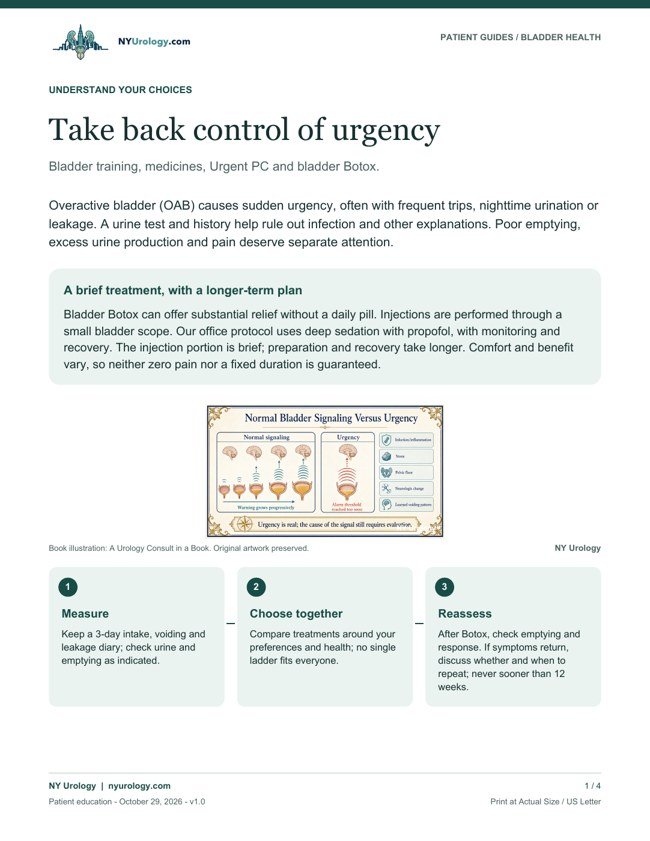
Overactive bladder (OAB) causes sudden urgency, often with frequent trips, nighttime urination or leakage. A urine test and history help rule out infection and other explanations. Poor emptying, excess urine production and pain deserve separate attention.
A brief treatment, with a longer-term plan
Bladder Botox can offer substantial relief without a daily pill. Injections are performed through a small bladder scope. Our office protocol uses deep sedation with propofol, with monitoring and recovery. The injection portion is brief; preparation and recovery take longer. Comfort and benefit vary, so neither zero pain nor a fixed duration is guaranteed.
Compare the options
| Option | Why consider it | What to weigh |
|---|---|---|
| Bladder and pelvic-floor strategies | A diary, planned voiding and urge-control techniques can improve control. | Adjust fluids and caffeine without becoming dehydrated. Pelvic-floor therapy should match muscle function. |
| Beta-3 agonists | Mirabegron and vibegron help the bladder store urine. | Review interactions and emptying risk. Mirabegron can raise blood pressure; individual medicines differ. |
| Antimuscarinics | Examples: oxybutynin, tolterodine, solifenacin, darifenacin, fesoterodine and trospium. | Dry mouth, constipation and retention can occur. Discuss cognitive risk, glaucoma history and total anticholinergic burden. |
| Urgent PC (PTNS) | A fine needle near the ankle delivers tibial-nerve stimulation; no bladder injection or daily medicine. | A typical start is 12 weekly, roughly 30-minute sessions; responders often need maintenance. Confirm device-specific precautions. |
| Bladder Botox | OnabotulinumtoxinA relaxes bladder activity and can reduce urgency leakage. | Benefit often lasts several months, commonly around 6 months. UTI, burning, blood in urine and retention are possible; some patients need temporary self-catheterization. |
| Sacral neuromodulation | A staged nerve-stimulation approach can help selected patients. | Involves a trial and possibly an implanted device, with its own follow-up and procedure risks. |
Our office approach
How our practice provides care, alongside the general options above.
The least invasive effective path
We prioritize effective care with less procedural burden when it fits your diagnosis, anatomy and goals. Our interventional service invests in advanced imaging for targeted procedures; equipment and manufacturers change over time. Imaging, contrast, radiation and anesthesia are discussed for your particular treatment.
Focused ultrasound expertise
Our practice provides modern in-office ultrasound for urology, gynecology and interventional care. Experienced, dedicated ultrasound technologists focus on these specialties, with much of their work in urology. An in-house radiologist interprets images, and treating physicians trained in image interpretation also review relevant studies. Ultrasound uses no ionizing radiation; CT, MRI or other tests may still be needed.
Prompt answers and a clear follow-up plan
We usually generate ultrasound reports and explain the findings and follow-up to patients the same day. Some studies need additional review, and turnaround varies. Ask what the result means and what happens next. Confirm your service and location before visiting.
More of your evaluation in one place
In-office blood collection and urine testing can reduce separate testing visits; preparation and result timing depend on the test. Bladder ultrasound can measure urine remaining after urination. For suitable men, we favor noninvasive UroCuff pressure-flow assessment when it can answer the question, rather than routine catheter-based urodynamics. These tests are not interchangeable; complex cases may need additional studies.
Questions to ask
- Is this OAB, infection, poor emptying or another problem?
- Which medication class best fits my health and other medicines?
- What anesthesia and recovery should I expect for Botox?
- If I cannot empty afterward, who will help and how will we check?
What you can do now
- Do not force large volumes of water or stop drinking to avoid trips. Ask for an individualized fluid plan.
- Before Botox, discuss infection screening, blood thinners, allergies and possible temporary catheterization. Follow fasting instructions and arrange an adult escort home after propofol sedation; do not drive afterward.
- Repeat treatment is based on returning symptoms and clinical assessment, not an automatic six-month appointment.
When to seek urgent care
Seek urgent care if you cannot urinate, develop fever with urinary symptoms or feel seriously unwell. After Botox, breathing or swallowing difficulty or generalized weakness needs emergency assessment.
Further reading and sources
- doi.org — clinical reference 1
- www.rxabbvie.com — clinical reference 2
- www.laborie.com — clinical reference 3
Further reading: A Urology Consult in a Book, by David Shusterman, MD.