
Patient education · English edition · October 29, 2026
An elevated PSA: what happens next?
A risk signal deserves a thoughtful process, not panic.
PSA is a protein made by prostate tissue. A high result can reflect benign enlargement, inflammation, infection, recent urinary procedures or cancer. A single number cannot establish the diagnosis or decide treatment.
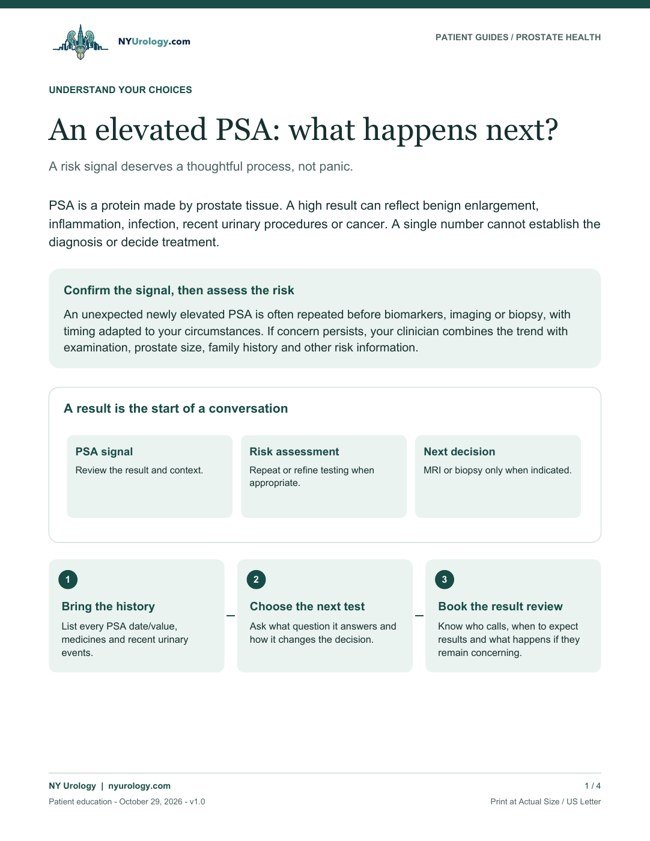
Confirm the signal, then assess the risk
An unexpected newly elevated PSA is often repeated before biomarkers, imaging or biopsy, with timing adapted to your circumstances. If concern persists, your clinician combines the trend with examination, prostate size, family history and other risk information.
Compare the options
| Option | Why consider it | What to weigh |
|---|---|---|
| Review the context | Check prior results, urinary infection/retention, recent procedures, medicines and temporary influences. | Finasteride and dutasteride lower PSA; the number needs adjusted interpretation. Do not stop them on your own. |
| Repeat when appropriate | A repeat can help distinguish a temporary change from persistent elevation. | Agree on timing; serious symptoms or high-risk findings may change the pace. Antibiotics are not a routine way to lower PSA without evidence of infection. |
| Refine the risk | A validated risk calculator, PSA density, selected blood/urine biomarkers or MRI may help. | Use a test when its result could change the biopsy decision. None rules cancer in or out perfectly. |
| Discuss biopsy | MRI-targeted and/or systematic sampling may establish whether cancer is present and its Grade Group. | Discuss transperineal versus transrectal access, infection prevention, bleeding, discomfort and retention. |
| Close the loop | Review the actual pathology and agree on follow-up even if MRI or biopsy is reassuring. | A negative test does not erase all future risk. PSA velocity alone should not drive biopsy. |
Our office approach
How our practice provides care, alongside the general options above.
The least invasive effective path
We prioritize effective care with less procedural burden when it fits your diagnosis, anatomy and goals. Our interventional service invests in advanced imaging for targeted procedures; equipment and manufacturers change over time. Imaging, contrast, radiation and anesthesia are discussed for your particular treatment.
Focused ultrasound expertise
Our practice provides modern in-office ultrasound for urology, gynecology and interventional care. Experienced, dedicated ultrasound technologists focus on these specialties, with much of their work in urology. An in-house radiologist interprets images, and treating physicians trained in image interpretation also review relevant studies. Ultrasound uses no ionizing radiation; CT, MRI or other tests may still be needed.
Prompt answers and a clear follow-up plan
We usually generate ultrasound reports and explain the findings and follow-up to patients the same day. Some studies need additional review, and turnaround varies. Ask what the result means and what happens next. Confirm your service and location before visiting.
More of your evaluation in one place
In-office blood collection and urine testing can reduce separate testing visits; preparation and result timing depend on the test. Bladder ultrasound can measure urine remaining after urination. For suitable men, we favor noninvasive UroCuff pressure-flow assessment when it can answer the question, rather than routine catheter-based urodynamics. These tests are not interchangeable; complex cases may need additional studies.
Questions to ask
- Should we repeat this PSA, and when?
- What is my risk of clinically significant cancer rather than any cancer?
- Would MRI or a biomarker actually change whether I need biopsy?
- If the next test is negative, what follow-up do I still need?
What you can do now
- Tell the clinician about family history, inherited cancer risks and prior biopsies.
- Follow the laboratory/clinician instructions before repeat testing; do not diagnose yourself from an online threshold.
- Ask for a written next step and date so an abnormal result is neither rushed nor lost.
When to seek urgent care
Fever, chills, severe urinary pain, inability to urinate or feeling acutely ill needs prompt assessment. PSA itself is usually a follow-up issue, but these symptoms can indicate an urgent problem.
Further reading and sources
Further reading: A Urology Consult in a Book, by David Shusterman, MD.