
Patient education · English edition · October 29, 2026
Hydrocele: drainage or surgery?
Compare immediate relief, recovery and the chance fluid returns.
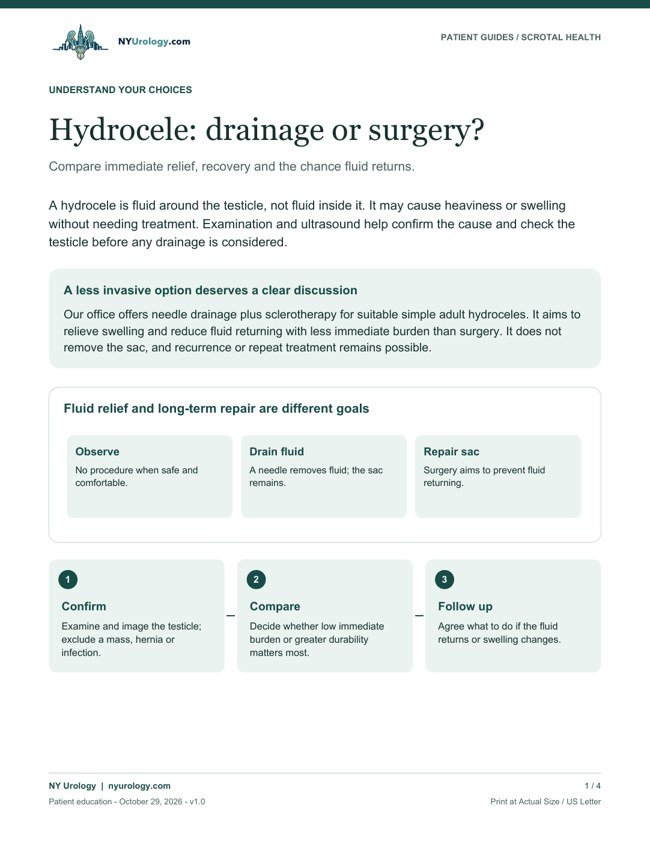
A hydrocele is fluid around the testicle, not fluid inside it. It may cause heaviness or swelling without needing treatment. Examination and ultrasound help confirm the cause and check the testicle before any drainage is considered.
A less invasive option deserves a clear discussion
Our office offers needle drainage plus sclerotherapy for suitable simple adult hydroceles. It aims to relieve swelling and reduce fluid returning with less immediate burden than surgery. It does not remove the sac, and recurrence or repeat treatment remains possible.
Compare the options
| Option | Why consider it | What to weigh |
|---|---|---|
| Observation | Avoids a procedure when the swelling is mild and the diagnosis is secure. | Arrange review if it grows, hurts or changes. A new mass should not be presumed to be a hydrocele. |
| Needle aspiration alone | Fluid is removed through the skin, usually with local numbing. | Fluid commonly returns, sometimes quickly. Repeat drainage, bleeding and infection are possible; it is not equivalent to definitive sac repair. |
| Aspiration plus sclerotherapy | After drainage, a medicine may be used to reduce fluid re-accumulation in selected adults. | Pain, inflammation and recurrence can occur; more than one session may be needed. Confirm the proposed agent, evidence and availability. |
| Hydrocelectomy | An incision allows the surgeon to repair or remove part of the sac; generally more durable. | Anesthesia, bruising, swelling, infection, hematoma and a longer recovery are tradeoffs. Recurrence is still possible. |
Our office approach
How our practice provides care, alongside the general options above.
The least invasive effective path
We prioritize effective care with less procedural burden when it fits your diagnosis, anatomy and goals. Our interventional service invests in advanced imaging for targeted procedures; equipment and manufacturers change over time. Imaging, contrast, radiation and anesthesia are discussed for your particular treatment.
Focused ultrasound expertise
Our practice provides modern in-office ultrasound for urology, gynecology and interventional care. Experienced, dedicated ultrasound technologists focus on these specialties, with much of their work in urology. An in-house radiologist interprets images, and treating physicians trained in image interpretation also review relevant studies. Ultrasound uses no ionizing radiation; CT, MRI or other tests may still be needed.
Prompt answers and a clear follow-up plan
We usually generate ultrasound reports and explain the findings and follow-up to patients the same day. Some studies need additional review, and turnaround varies. Ask what the result means and what happens next. Confirm your service and location before visiting.
More of your evaluation in one place
In-office blood collection and urine testing can reduce separate testing visits; preparation and result timing depend on the test. Bladder ultrasound can measure urine remaining after urination. For suitable men, we favor noninvasive UroCuff pressure-flow assessment when it can answer the question, rather than routine catheter-based urodynamics. These tests are not interchangeable; complex cases may need additional studies.
Questions to ask
- Is this a simple hydrocele, and is my testicle normal on ultrasound?
- Are you proposing aspiration alone or adding sclerotherapy?
- What chance of recurrence should I expect with this exact approach?
- What finding would make surgery the safer or more durable choice?
What you can do now
- Tell the team about blood thinners, previous scrotal surgery and infection symptoms.
- Complex, loculated, infected or hernia-associated swellings may need a different plan.
- Arrange specific instructions for activity, wound care and follow-up; do not attempt home drainage.
When to seek urgent care
Sudden severe testicular pain, nausea, a red painful scrotum, fever or a new firm testicular lump needs prompt assessment. Sudden severe pain is an emergency because torsion can threaten the testicle.
Further reading and sources
Further reading: A Urology Consult in a Book, by David Shusterman, MD.