
Patient education · English edition · October 29, 2026
Living with bladder pain
A practical guide to interstitial cystitis / bladder pain syndrome.
Interstitial cystitis/bladder pain syndrome (IC/BPS) can cause bladder or pelvic pain, pressure and frequent trips. Symptoms vary, and infection and other explanations need to be excluded. The goal is a sustainable plan that improves comfort and daily function.
Find your triggers without shrinking your life
There is no universal forbidden-food list. Keep a food-and-symptom diary, test one suspected trigger at a time and reintroduce tolerated foods. A restrictive diet that does not help should not become a permanent burden.
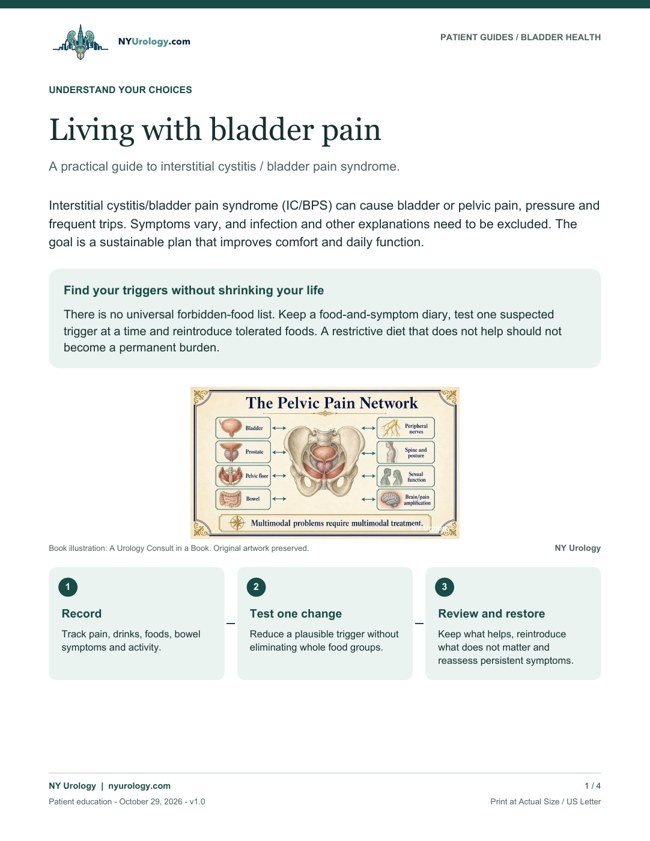
Compare the options
| Option | Why consider it | What to weigh |
|---|---|---|
| Food and drink | Common triggers include coffee/caffeine, alcohol, citrus, tomatoes, spicy foods, fizzy drinks or artificial sweeteners. | These are possibilities, not a ban for everyone. Work with a dietitian if the diet becomes narrow. |
| Fluids and bowel habits | Steady, individualized hydration and constipation management can help. | Avoid both dehydration and forced excessive drinking. Other health conditions may limit fluid intake. |
| Movement and sitting | Gentle walking, stretching, breaks from prolonged sitting and symptom-guided activity are reasonable. | Modify activities that reliably flare pain; do not assume all exercise or sexual activity is prohibited. |
| Pelvic-floor care | A therapist may help relax painful or overactive muscles. | Repeated strengthening/Kegels can worsen a tight pelvic floor; use a tailored assessment. |
| Medical treatment | Options may include medicines, bladder instillations and treatment of Hunner lesions when present. | Choice depends on the pattern. Ask about risks, including eye monitoring if pentosan polysulfate is proposed; procedures are not a guaranteed cure. |
Our office approach
How our practice provides care, alongside the general options above.
The least invasive effective path
We prioritize effective care with less procedural burden when it fits your diagnosis, anatomy and goals. Our interventional service invests in advanced imaging for targeted procedures; equipment and manufacturers change over time. Imaging, contrast, radiation and anesthesia are discussed for your particular treatment.
Focused ultrasound expertise
Our practice provides modern in-office ultrasound for urology, gynecology and interventional care. Experienced, dedicated ultrasound technologists focus on these specialties, with much of their work in urology. An in-house radiologist interprets images, and treating physicians trained in image interpretation also review relevant studies. Ultrasound uses no ionizing radiation; CT, MRI or other tests may still be needed.
Prompt answers and a clear follow-up plan
We usually generate ultrasound reports and explain the findings and follow-up to patients the same day. Some studies need additional review, and turnaround varies. Ask what the result means and what happens next. Confirm your service and location before visiting.
More of your evaluation in one place
In-office blood collection and urine testing can reduce separate testing visits; preparation and result timing depend on the test. Bladder ultrasound can measure urine remaining after urination. For suitable men, we favor noninvasive UroCuff pressure-flow assessment when it can answer the question, rather than routine catheter-based urodynamics. These tests are not interchangeable; complex cases may need additional studies.
Questions to ask
- Have infection and other causes of bladder pain been excluded?
- Is my pelvic floor tight or tender?
- What is the goal of this treatment, and when will we reassess?
- Do my symptoms suggest Hunner lesions or another targeted evaluation?
What you can do now
- Use a comfortable heat pack or other agreed flare strategy; protect skin from burns.
- Discuss comfortable positioning and pauses during sex rather than a blanket restriction.
- New symptoms should not automatically be labeled another IC flare. Avoid repeated antibiotics without evidence of infection.
When to seek urgent care
Fever, visible blood in urine, inability to urinate, new severe flank pain or rapidly worsening symptoms needs prompt evaluation rather than self-treatment as a familiar flare.
Further reading and sources
Further reading: A Urology Consult in a Book, by David Shusterman, MD.