
Patient education · English edition · October 29, 2026
Kidney stones: can I avoid a stent?
Compare stent-sparing treatment with the situations that need drainage.
Shock-wave lithotripsy (SWL/ESWL) breaks suitable stones using waves delivered from outside the body. Fragments pass in urine. Many suitable patients can be treated without a ureteral stent, but the safest choice depends on size, density, location, drainage and infection risk.
Stent-sparing is a goal, not a promise
Dr. Shusterman favors office-based shock-wave treatment when it offers a reasonable chance of clearing the stone with less instrumentation. A stent can still protect the kidney when drainage is threatened. Avoiding a needed stent is not safer than using one.
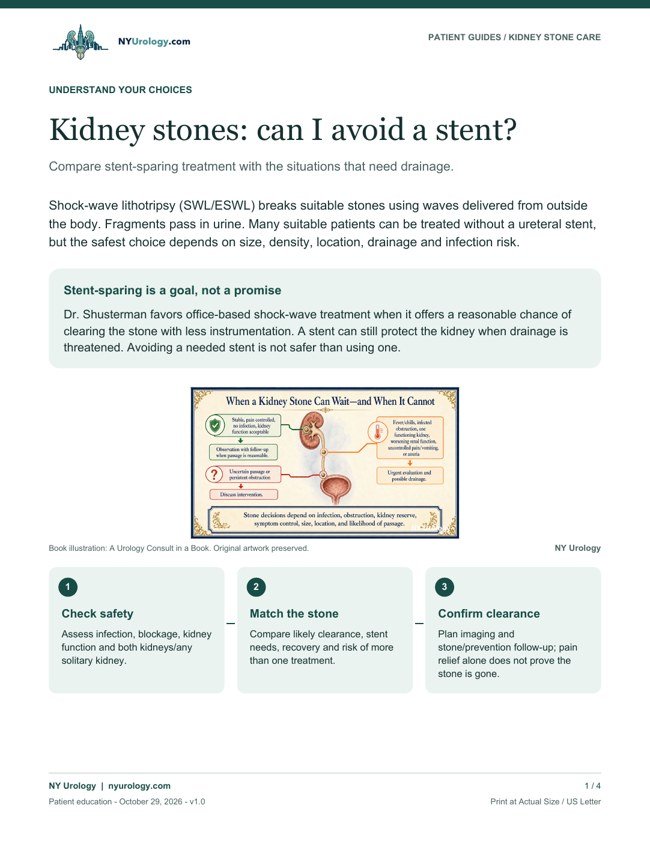
Compare the options
| Option | Why consider it | What to weigh |
|---|---|---|
| Observation / passage support | Selected small stones can pass with monitoring and symptom treatment; selected medicines may assist ureteral passage. | Not appropriate for infection with obstruction, threatened kidney function, uncontrolled symptoms or unreliable follow-up. |
| Shock-wave lithotripsy | No scope needs to enter the ureter; a stent is often unnecessary in suitable cases. | Fragments must pass; repeat sessions or another procedure may be needed. Hard, large, poorly positioned or difficult-to-target stones may respond less well. |
| Ureteroscopy with laser | A scope reaches and treats the stone directly; may offer better one-procedure clearance in some settings. | Anesthesia, ureteral injury and infection risks; a temporary stent is often used. Selected uncomplicated cases can omit it. |
| Percutaneous nephrolithotomy (PCNL) | Removes large or complex kidney stones through a small tract into the kidney. | More procedural burden, bleeding/infection risk and possible admission; often the effective choice for substantial stone burden. |
| Urgent drainage: stent or nephrostomy | A stent drains internally; a nephrostomy tube drains through the back. Both can relieve a blocked kidney. | With infection and obstruction, drainage plus antibiotics comes first; definitive stone treatment waits until infection is controlled. |
Our office approach
How our practice provides care, alongside the general options above.
The least invasive effective path
We prioritize effective care with less procedural burden when it fits your diagnosis, anatomy and goals. Our interventional service invests in advanced imaging for targeted procedures; equipment and manufacturers change over time. Imaging, contrast, radiation and anesthesia are discussed for your particular treatment.
Focused ultrasound expertise
Our practice provides modern in-office ultrasound for urology, gynecology and interventional care. Experienced, dedicated ultrasound technologists focus on these specialties, with much of their work in urology. An in-house radiologist interprets images, and treating physicians trained in image interpretation also review relevant studies. Ultrasound uses no ionizing radiation; CT, MRI or other tests may still be needed.
Prompt answers and a clear follow-up plan
We usually generate ultrasound reports and explain the findings and follow-up to patients the same day. Some studies need additional review, and turnaround varies. Ask what the result means and what happens next. Confirm your service and location before visiting.
More of your evaluation in one place
In-office blood collection and urine testing can reduce separate testing visits; preparation and result timing depend on the test. Bladder ultrasound can measure urine remaining after urination. For suitable men, we favor noninvasive UroCuff pressure-flow assessment when it can answer the question, rather than routine catheter-based urodynamics. These tests are not interchangeable; complex cases may need additional studies.
Questions to ask
- Why is SWL suitable or unsuitable for my stone?
- Can my treatment safely be stent-free?
- If a stent is needed, why, and what is the removal date?
- What is the backup plan if fragments do not pass?
What you can do now
- Do not wait for a scheduled office lithotripsy session if you have fever or other urgent symptoms.
- Blocked drainage on both sides, a solitary kidney, declining kidney function or severe symptoms can require urgent action.
- Office SWL is scheduled according to evaluation and availability. Ask about preparation, anesthesia, medicines and follow-up; never stop blood thinners without instructions.
When to seek urgent care
Fever or shaking chills with a suspected stone, little/no urine, uncontrolled pain, persistent vomiting or feeling seriously unwell needs urgent assessment. An infected obstructed kidney is an emergency.
Further reading and sources
Further reading: Stones Unlocked, by David Shusterman, MD.