
Patient education · English edition · October 29, 2026
Prostate cancer: treat or monitor?
Start with the risk of the cancer, then consider the burden of treatment.
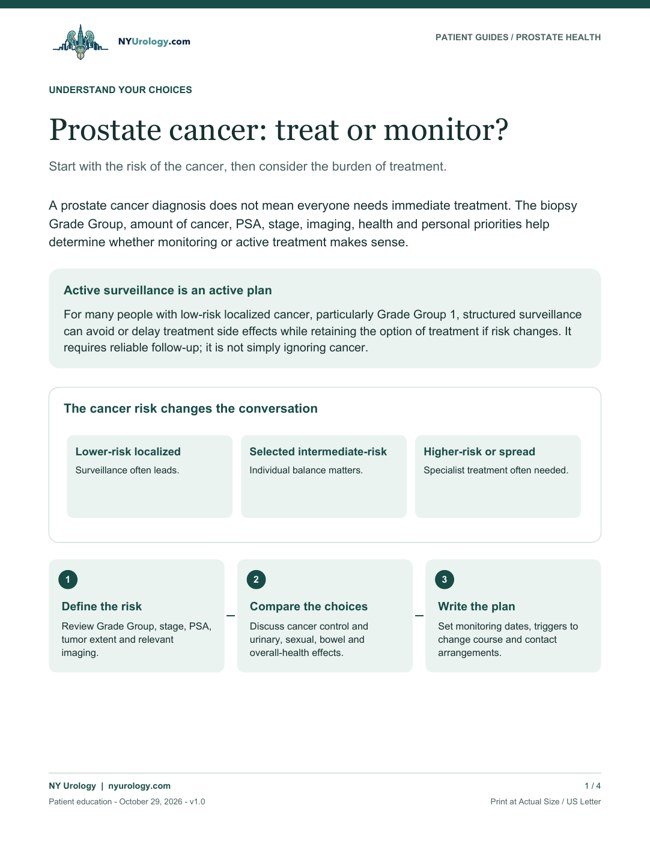
A prostate cancer diagnosis does not mean everyone needs immediate treatment. The biopsy Grade Group, amount of cancer, PSA, stage, imaging, health and personal priorities help determine whether monitoring or active treatment makes sense.
Active surveillance is an active plan
For many people with low-risk localized cancer, particularly Grade Group 1, structured surveillance can avoid or delay treatment side effects while retaining the option of treatment if risk changes. It requires reliable follow-up; it is not simply ignoring cancer.
Compare the options
| Option | Why consider it | What to weigh |
|---|---|---|
| Active surveillance | Regular PSA and clinical review, with MRI and repeat biopsy as appropriate; treatment if the cancer is reclassified or progresses. | Often preferred for low-risk disease. Selected favorable intermediate-risk cases require careful counseling; it is not a guarantee against progression. |
| Watchful waiting / observation | Focuses on symptoms and quality of life rather than repeated testing aimed at later cure. | May fit limited life expectancy or substantial competing illness. Different purpose from active surveillance. |
| Radical prostatectomy | Removes the prostate and provides detailed pathology; a curative option for selected localized cancers. | Can affect continence, erections, ejaculation and fertility. Recovery, surgical risk and possible additional treatment matter. |
| Radiation therapy | External-beam treatment or brachytherapy can treat suitable localized cancer; hormone treatment may be added according to risk. | Urinary, bowel and sexual effects differ from surgery; hormone therapy adds its own burdens when used. |
| Focal treatment | Treats a selected area in carefully chosen situations. | Long-term comparative evidence and follow-up needs differ; ask about trials and the risk of untreated cancer elsewhere. |
| Higher-risk or spread disease | May need combined radiation, hormone/systemic treatment and specialist oncology input. | A localized-disease comparison is insufficient. Staging and a coordinated plan are essential. |
Our office approach
How our practice provides care, alongside the general options above.
The least invasive effective path
We prioritize effective care with less procedural burden when it fits your diagnosis, anatomy and goals. Our interventional service invests in advanced imaging for targeted procedures; equipment and manufacturers change over time. Imaging, contrast, radiation and anesthesia are discussed for your particular treatment.
Focused ultrasound expertise
Our practice provides modern in-office ultrasound for urology, gynecology and interventional care. Experienced, dedicated ultrasound technologists focus on these specialties, with much of their work in urology. An in-house radiologist interprets images, and treating physicians trained in image interpretation also review relevant studies. Ultrasound uses no ionizing radiation; CT, MRI or other tests may still be needed.
Prompt answers and a clear follow-up plan
We usually generate ultrasound reports and explain the findings and follow-up to patients the same day. Some studies need additional review, and turnaround varies. Ask what the result means and what happens next. Confirm your service and location before visiting.
More of your evaluation in one place
In-office blood collection and urine testing can reduce separate testing visits; preparation and result timing depend on the test. Bladder ultrasound can measure urine remaining after urination. For suitable men, we favor noninvasive UroCuff pressure-flow assessment when it can answer the question, rather than routine catheter-based urodynamics. These tests are not interchangeable; complex cases may need additional studies.
Questions to ask
- What is my exact risk group, and why?
- Am I a good surveillance candidate, and what would trigger treatment?
- How do surgery and radiation compare for someone like me?
- Would a second pathology opinion or multidisciplinary review help?
What you can do now
- Obtain copies of the biopsy report, imaging and PSA history. Do not choose from PSA alone.
- Discuss family history and whether inherited-risk or tumor testing would change care.
- Do not miss surveillance tests; a new PSA rise needs interpretation rather than an automatic treatment switch.
When to seek urgent care
New leg weakness, trouble walking, loss of bowel/bladder control or severe back pain can require emergency evaluation, especially with known advanced cancer. Inability to urinate also needs urgent care.
Further reading and sources
Further reading: A Urology Consult in a Book, by David Shusterman, MD.