
Home · Conditions · Peyronie's Disease
Peyronie's disease
Peyronie's Disease
Explore the illustrated guide ↓
A bend in the penis from Peyronie's disease can usually be improved without surgery. Our focus is non-surgical correction — Xiaflex plaque injections, low-intensity shockwave, and PRP — to reduce curvature and restore function.
A curve that develops over time — and what causes it
Peyronie's disease is a buildup of fibrous scar tissue (a "plaque") inside the penis that causes a bend or curve, sometimes pain, and often difficulty with intercourse. It frequently goes hand-in-hand with erectile dysfunction. The good news: for most men it can be improved without surgery, and that's where we focus.
Xiaflex — the leading non-surgical treatment
How it works
Xiaflex (collagenase clostridium histolyticum) is the only FDA-approved injectable for Peyronie's disease. It's injected directly into the plaque, where the enzyme breaks down the collagen scar tissue that's causing the bend. Combined with penile modeling, a course of injections can meaningfully reduce curvature. It's an in-office treatment and a true alternative to surgery for appropriate men.
Experience that matters
Xiaflex is technique-dependent — where and how the plaque is injected, and how modeling is done, affects results. Dr. Shusterman has extensive hands-on experience with Xiaflex for Peyronie's, which is exactly the kind of procedure where an experienced injector makes a difference.
Low-intensity shockwave
We also offer low-intensity shockwave therapy (the same acoustic-wave technology behind our ErectionWave program) as part of a non-surgical approach — it can help with pain and is often combined with other treatment.
PRP (the "P-shot")
For some men we offer platelet-rich plasma (PRP), sometimes called the P-shot — an injection of concentrated growth factors from your own blood, used as part of a regenerative, non-surgical approach to curvature and function.
Why it matters
Done in the office, not the hospital
Because we have a combined urology and interventional radiology team in-office, we diagnose and treat the large majority of what we do right here — see how our in-office model works.
When to see us
If you've noticed a new curve, a lump you can feel, pain with erections, or difficulty with intercourse, it's worth an evaluation — earlier treatment often works better. Call (212) 991-9991 or book a consultation.
Common questions
Can Peyronie's disease be treated without surgery?
Non-surgical treatment may be appropriate for selected patients. Xiaflex is FDA-approved for adult men with a palpable plaque and penile curvature of at least 30 degrees when treatment begins. Eligibility, risks and alternatives require an individual assessment; treatment is not a guarantee of a particular result. A urologist can explain whether an injectable treatment or surgery is appropriate.
What is Xiaflex?
Xiaflex (collagenase clostridium histolyticum) is the only FDA-approved injectable for Peyronie's disease. It's injected into the plaque to break down the collagen scar tissue causing the curve, and is combined with penile modeling. Dr. Shusterman has extensive experience performing it.
Does Xiaflex hurt, and where is it injected?
It's an in-office injection placed directly into the Peyronie's plaque, not the rest of the penis. Most men tolerate it well; mild bruising or swelling can occur. The procedure itself takes only seconds per injection.
How much can the curve improve?
Results vary by individual, plaque, and degree of curvature, but studies of Xiaflex show meaningful average reductions in curvature, and an experienced injector helps optimize the outcome. We'll set realistic expectations based on your exam.
Is Peyronie's linked to erectile dysfunction?
Often, yes — the two frequently occur together. We evaluate and treat both, and can coordinate ED care including shockwave therapy and hormone optimization where appropriate.
UNDERSTAND YOUR CARE
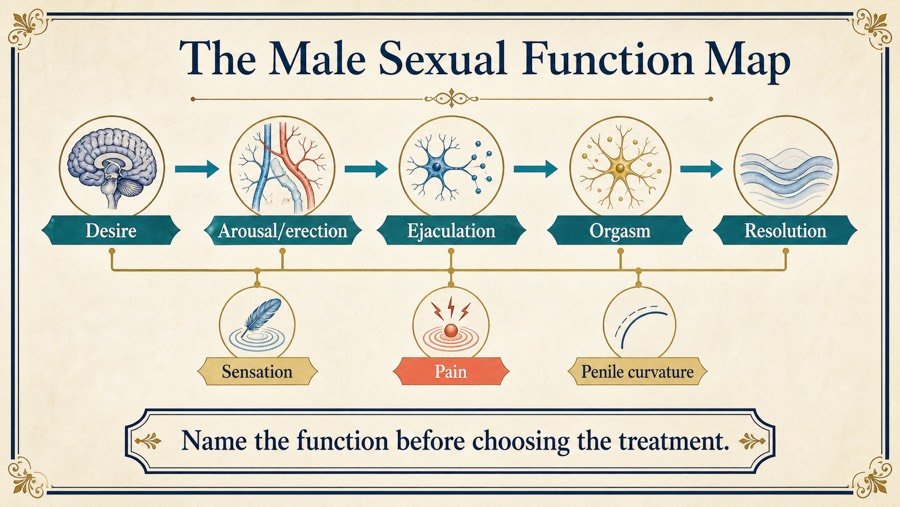
Describe the change in shape and the effect on function
Penile curvature becomes a treatment question when its cause, timing and effect on sexual function are understood. Pain, narrowing, shortening, erection quality and difficulty with intercourse may matter as much as the angle.
Establish what is changing
A newly acquired bend is different from a lifelong stable shape. The clinician asks when it began, whether pain or curvature is still evolving, and whether an indentation, hinge effect or loss of length is present. Examination and selected assessment help distinguish Peyronie’s disease from other conditions.
The emotional effect is part of care. Avoiding intimacy, fear of injury and difficulty discussing the change can add burdens that a measurement alone cannot capture. Explain what function you hope to regain. Any clinical photographs should be handled only through an approved secure process after the office explains what is needed; do not email intimate images to an ordinary inbox.
Timing changes the treatment discussion
Management considers whether the condition is evolving or stable, the degree and type of deformity, erection quality and patient goals. Observation, selected nonsurgical options and surgery have different roles. Not every person with curvature needs an intervention, and not every treatment is suitable for every deformity.
Surgical choices can involve tradeoffs between straightening, length, sensation and erectile function. An implant may be discussed in selected patients with significant ED as well as deformity. Ask what the proposed treatment can reasonably change, what it cannot restore and what recovery involves. Preserving communication and comfortable intimacy while evaluation proceeds can be valuable; success should be described in functional terms rather than a promise of a perfectly straight or restored penis.
Questions to bring to your visit
- Is the condition still changing or has it become stable?
- How do the shape change and erection quality affect my options?
- What are the realistic tradeoffs for length, sensation, recovery and function?
When to seek care: A sudden injury with a popping sensation, major swelling or bruising, or abrupt loss of erection can indicate penile fracture and needs emergency assessment.
Explanation adapted from A Urology Consult in a Book by David Shusterman, MD, chapter 26, “Ejaculation, Orgasm, And Penile Curvature.” Original illustration reproduced from the book. NIDDK: penile curvature.

Prepare for your visit with a book by Dr. David Shusterman
A Urology Consult in a Book explains symptoms, evaluation and treatment choices. Bring your questions to your clinician; the book supports that conversation.
Explore the books and care team →Take care of the basics.
Book a men's-health visit at our Manhattan or Forest Hills office — a simple step that's easy to keep putting off.

Manhattan & Queens · All Five Boroughs