
Home · Conditions · Priapism
Urgent men's health
Priapism
Explore the illustrated guide ↓
An erection lasting four hours or more needs emergency evaluation. Prompt treatment can reduce the risk of permanent erectile-tissue damage. Do not wait for a routine appointment.
See it illustrated
Explore selected illustrations, then open a guide to see the full image and related reading.
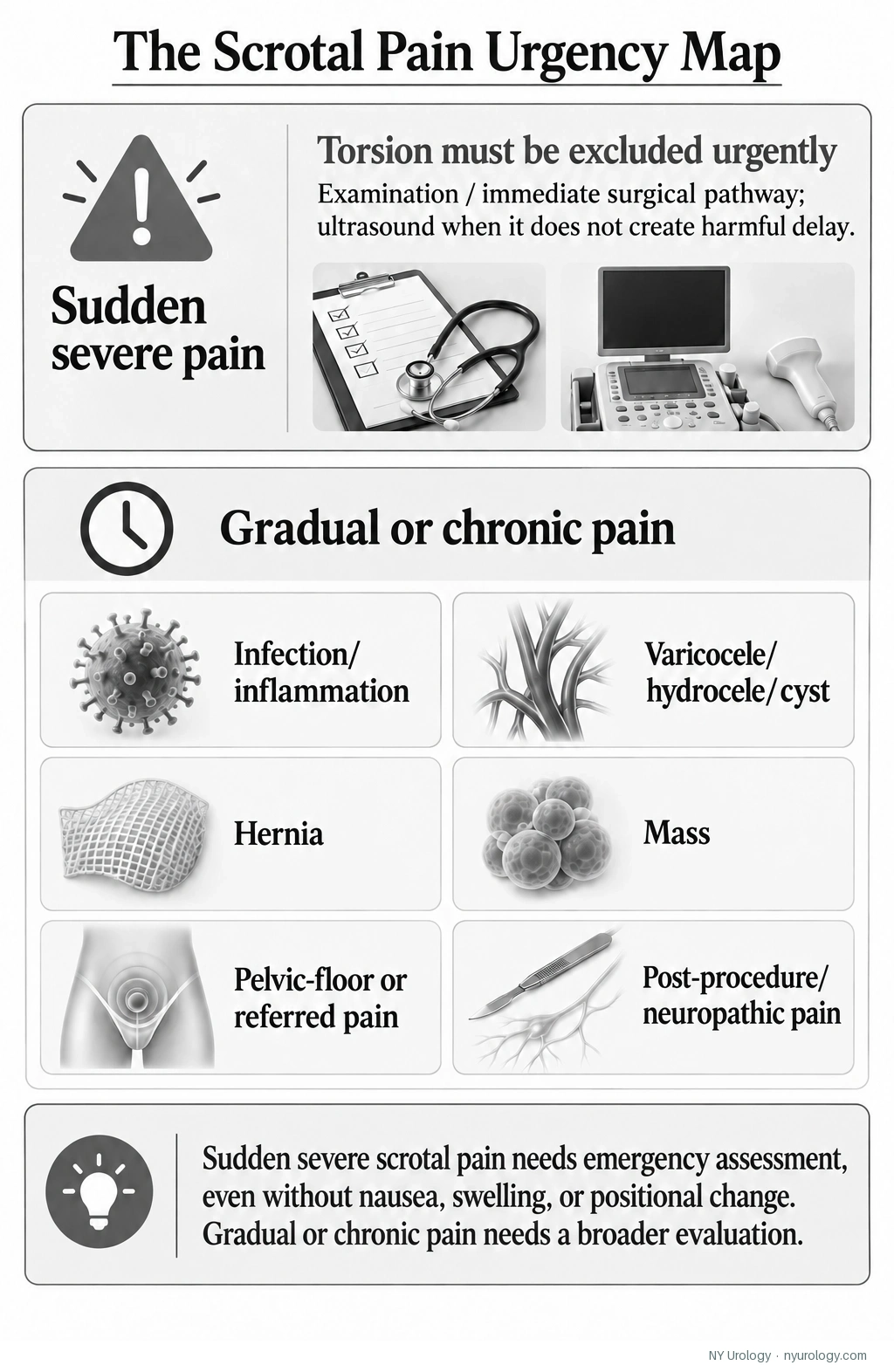
The Scrotal Pain Urgency Map
Open illustrated guide →
The Anatomy of a Great Urology Visit
Open illustrated guide →If it is happening now
If an erection has lasted four hours or more, go to the nearest emergency department now. Call 911 if you need emergency assistance. Do not wait for an office callback or for the erection to go away on its own.
Two very different kinds
Low-flow, or ischemic, priapism is the common and dangerous type. The mechanism that traps blood to maintain an erection locks in place, fresh arterial blood can no longer enter, and the tissue is starved of oxygen. It is usually painful and rigid.
High-flow priapism is rare, typically follows an injury to the groin or penis, is often painless, and does not destroy tissue in the same way. It is managed differently, sometimes with observation or embolization.
Common causes
The most common cause we see is injection therapy for erectile dysfunction, particularly Trimix, and especially when an injection is combined with a pill such as sildenafil or tadalafil. Never stack them. Other causes include sickle cell disease and sickle cell trait, certain psychiatric and blood pressure medications, recreational drugs, and occasionally blood disorders.
How it is treated
Medication injected into the penis
The first step is an injection of phenylephrine, which constricts the blood vessels and lets blood drain. One or two rounds resolve the large majority of cases.
Aspiration and irrigation
If injections are not enough, blood is drawn out and the tissue is rinsed under good anesthesia, which resolves many of the remaining cases.
A shunt
Rarely, a small procedure creates a new drainage path. The earlier treatment starts, the less likely this is to be needed.
Preventing it with injection therapy
When we start a patient on Trimix, the first dose is given in our office so the right dose is found safely, starting low, because a small change in volume is a large change in effect. Men on injection therapy should know exactly what to do if an erection does not subside. Men with repeated, stuttering episodes can often be prevented with oral medication.
Book a consultation (212) 991-9991
Common questions
How long is too long for an erection?
Four hours. After that, seek care immediately; tissue damage becomes more likely after about four to six hours.
Can I combine Trimix with Viagra or Cialis?
No. Stacking an injection with a PDE5 pill is the most common preventable cause of priapism we see.
Will priapism affect my erections afterward?
When it is treated early, most men recover normal function. The longer it lasts, the higher the risk of permanent erectile dysfunction.
Is sickle cell trait a risk factor?
Yes. Both sickle cell disease and sickle cell trait increase the risk of priapism.
What should I do while I wait for care?
Get to care rather than waiting. Do not take more medication, and do not apply ice directly to the skin for long periods.
Sources for this information
AUA/SMSNA: PriapismUNDERSTAND YOUR CARE
A prolonged erection is a time-sensitive medical problem
An erection that persists for four hours requires emergency assessment, even when it began after a prescribed ED treatment. The immediate task is to identify whether blood flow and penile tissue are at risk.
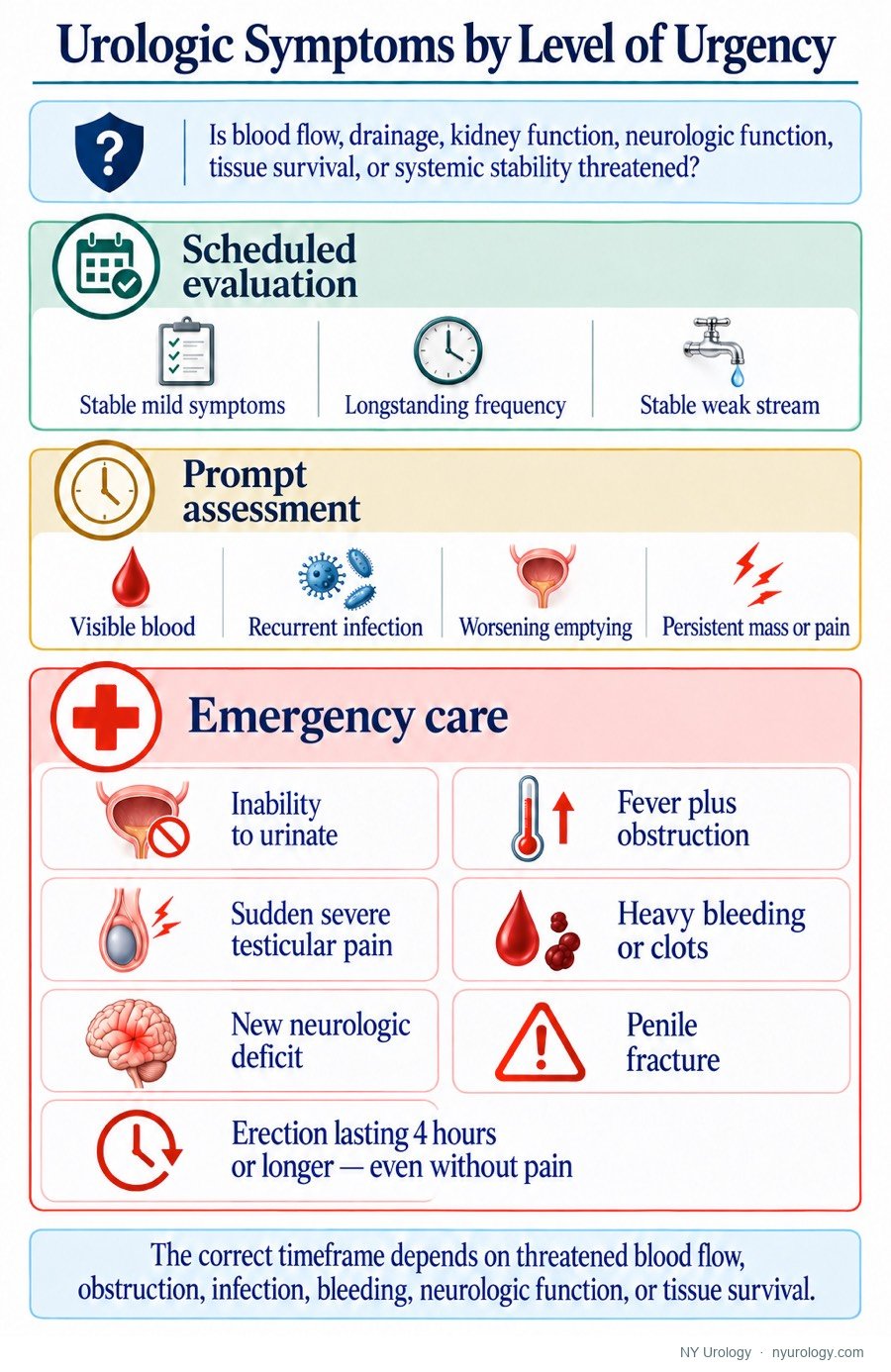
Do not wait for an office appointment
Painful ischemic priapism can injure tissue as time passes. Less painful high-flow patterns also need professional assessment; pain level alone cannot establish the type safely. Home experiments or waiting overnight can delay necessary treatment.
Tell the emergency team the duration, degree of pain, all medicines or injections used, recreational substances, prior episodes, relevant blood conditions and any injury. This information helps clinicians identify the mechanism and choose the urgent pathway. Bring the medication name or packaging when possible.
Emergency treatment and prevention are separate jobs
The emergency team may use examination, blood testing and selected blood-flow assessment to determine what is happening. Treatments are selected for the type and severity of priapism and may include urgent procedures. A prevention discussion follows stabilization; it should not delay emergency care.
After an episode, review the potential trigger and future ED medication or injection instructions with the treating clinician. Recurrent short episodes may also need a prevention plan, particularly with an underlying blood disorder or repeated medication-associated events. Ask what to do if symptoms return, whom to call, what duration requires emergency care and whether the original treatment needs to be changed. Do not repeat a provoking dose without medical advice. Follow-up also assesses erectile function and the effects of the episode, without assuming that successful drainage guarantees complete recovery.
Questions to bring to your visit
- What type of priapism occurred and what likely triggered it?
- How should my ED medicine or injection plan change?
- What exact emergency and prevention instructions should I follow if it recurs?
When to seek care: An erection persisting four hours needs emergency care. Seek help earlier for severe pain, injury or rapidly worsening symptoms; do not rely on this webpage for a home treatment protocol.
Explanation adapted from A Urology Consult in a Book by David Shusterman, MD, chapter 2, “What Makes A Urologic Problem Urgent?.” Original illustration reproduced from the book. EAU: sexual and reproductive health guidance.

Prepare for your visit with a book by Dr. David Shusterman
A Urology Consult in a Book explains symptoms, evaluation and treatment choices. Bring your questions to your clinician; the book supports that conversation.
Explore the books and care team →Take care of the basics.
Book a men's-health visit at our Manhattan or Forest Hills office — a simple step that's easy to keep putting off.

Manhattan & Queens · All Five Boroughs