
Home · Conditions · Prostate Cancer
Prostate cancer
Prostate Cancer
Explore the illustrated guide ↓
A prostate cancer diagnosis rarely means rushing to surgery. We take a least-invasive approach — active surveillance for low-risk disease, surgery reserved as a last resort, and CyberKnife (SBRT) radiation referral when treatment is truly needed.
A diagnosis doesn't always mean aggressive treatment
A prostate cancer diagnosis is frightening, but many prostate cancers — particularly low-risk, low-grade ones — grow so slowly that immediate treatment can do more harm than the cancer itself. New York Urology takes a deliberately least-invasive approach: we work to confirm exactly what kind of prostate cancer you have, and we don't rush to surgery.
How we find it: PSA, then a map, then tissue
Our detection pathway is deliberately clean. PSA is the trigger. When PSA raises concern, a prostate MRI comes before the needle — it maps the areas of concern, guides exactly where any tissue should be taken, and in some men reassures enough to defer biopsy altogether. Only then, if warranted, does biopsy obtain the tissue answer. Imaging the prostate before biopsying it is now the standard in high-quality pathways, and it's a real improvement over the old approach of sampling blindly without a map. Each step earns its place and informs the next.
Active surveillance first for low-risk disease
For many men with low-grade prostate cancer, the right first step is active surveillance — a structured program of monitoring with PSA (typically every six months), exams, imaging, and repeat biopsy at intervals (about every eighteen months), so that treatment happens only if and when the cancer shows it needs it. It is not passive neglect — it's an active protocol.
This also answers the old worry about PSA screening — that it "finds cancers that never needed finding." That argument held when finding any prostate cancer meant treating it. It no longer does: today, low-risk disease is watched, not operated on. Detection has been decoupled from treatment, and in my experience surveillance spares roughly half of these men — across a ten-year horizon — a treatment they would otherwise have undergone, keeping their continence, their potency, and their ordinary life. The one thing surveillance doesn't fix is screening the wrong men, which is why the right question isn't your age — it's your estimated life expectancy. The cancer worth finding is one significant enough to warrant treatment and slow enough that treating it will actually help.
Surgery is a last resort
We view radical surgery as a last resort, reserved for specific situations where it's truly the best option — not the default. In our experience it is uncommon for our prostate cancer patients to need surgery. When a cancer does call for active treatment, there are excellent, far less invasive ways to treat it.
CyberKnife (SBRT) when treatment is needed
What it is
When treatment is warranted, we coordinate referral to a CyberKnife center. CyberKnife is an advanced form of stereotactic body radiation therapy (SBRT) — a non-surgical, highly targeted radiation treatment that uses a robotic system to track the prostate and deliver precise doses while sparing nearby tissue like the bladder and rectum.
Five sessions, not forty
One of CyberKnife's biggest practical advantages is the schedule: a typical prostate course is five treatment sessions, compared with around 40 visits for conventional radiation. It's an outpatient treatment with no incision and no anesthesia, and clinical studies have reported strong cancer control with low toxicity in low- and intermediate-risk prostate cancer.
How our evaluation works
Good decisions start with a clear picture: your PSA trend, exam, imaging, and the grade and extent of cancer on biopsy. We use that to place you on the right path — surveillance, or, when needed, referral for the least-invasive effective treatment. Our goal throughout is to protect both your length and quality of life.
When to see us
If you have a rising PSA, an abnormal exam, or a new or existing prostate cancer diagnosis and want a least-invasive second opinion, we'd be glad to help. Call (212) 991-9991 or book a consultation. For enlarged-prostate (non-cancer) concerns, see our enlarged prostate (BPH) care and our dedicated prostate center.
Common questions
Does prostate cancer always need surgery?
No. Many low-grade prostate cancers grow very slowly, and for appropriately selected men the guideline-supported first step is active surveillance — careful monitoring — rather than immediate treatment. We reserve surgery as a last resort for specific situations, and it's uncommon for our patients to need it.
What is active surveillance (watchful waiting)?
Active surveillance is a structured monitoring program for low-risk prostate cancer — PSA testing, exams, imaging, and repeat biopsy when indicated — so that active treatment happens only if the cancer shows signs of progressing. It spares many men the side effects of treatment they may not need.
What is CyberKnife?
CyberKnife is an advanced form of stereotactic body radiation therapy (SBRT) — a non-surgical, highly targeted radiation treatment delivered by a robotic system that tracks the prostate and protects nearby tissue. When treatment is needed, we coordinate referral to a CyberKnife center.
How many CyberKnife treatments are needed?
A typical prostate CyberKnife course is about five sessions, compared with roughly 40 visits for conventional radiation. It's an outpatient treatment with no incision and no anesthesia.
Do you perform CyberKnife at your office?
CyberKnife is delivered at a dedicated radiation center, not in our office. We handle the evaluation, guide the decision, and coordinate referral to a CyberKnife center when that's the right treatment for you.
UNDERSTAND YOUR CARE
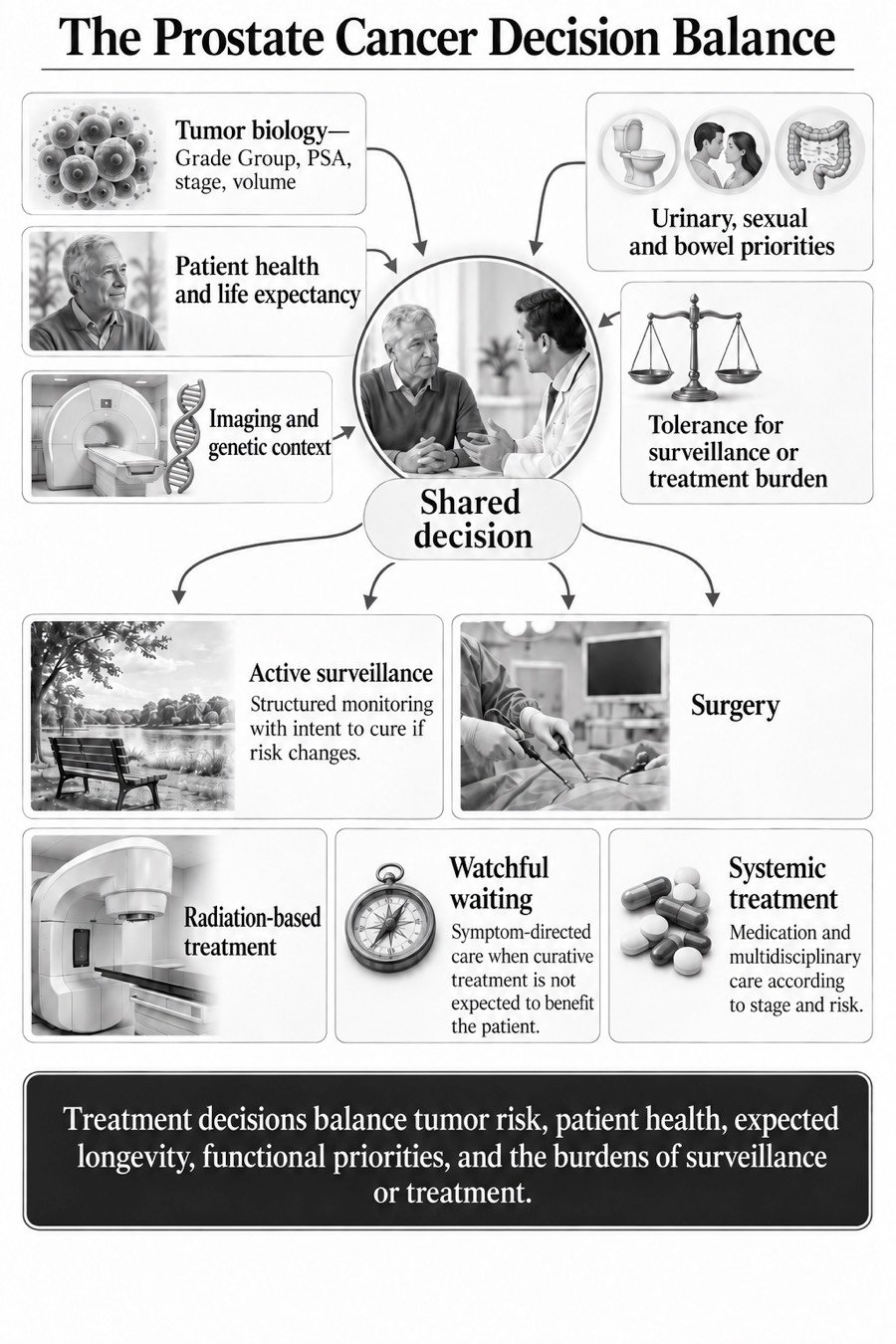
Balance cancer risk with the functions you want to preserve
A prostate cancer diagnosis does not identify one universal treatment. Tumor biology, stage, health, expected longevity and priorities for urinary, sexual and bowel function belong in the same decision.
Make sure you understand the diagnosis
Ask for the pathology report, including Grade Group or Gleason information, the amount of cancer sampled and relevant staging findings. PSA, imaging, examination and selected genetic information may add context. A suspicious scan and a confirmed tissue diagnosis answer different questions.
Some cancers are suitable for active surveillance, which is a structured program with the intention to act if risk changes. It is different from simply ignoring the diagnosis. Observation or watchful waiting has a different purpose in selected patients whose health and life expectancy make symptom-focused care more appropriate.
Compare complete pathways rather than isolated procedures
Surgery, radiation-based treatment, surveillance and systemic or combined pathways have different roles. Discuss how the risk category affects the options, what follow-up is required and which specialists should contribute. A second opinion can be useful when it checks the actual pathology and imaging rather than repeating an unsupported label.
Ask separately about cancer control and the chance of changes in continence, erections, ejaculation, bowel function and daily activity. Recovery and later treatment needs also matter. Not every option is equally appropriate for every stage or health context, and no clinician can promise an individual outcome from a population average. Write down the chosen pathway, the reason for it, the next review date and the finding that would trigger a change. The right plan should be understandable to you and coordinated across the clinicians involved.
Questions to bring to your visit
- What is my risk group, and which findings establish it?
- Am I a candidate for surveillance, and what exactly would that involve?
- How do reasonable treatments compare for cancer control and urinary, sexual and bowel effects?
When to seek care: New severe back pain with leg weakness, numbness or bladder/bowel dysfunction requires emergency assessment. Other new or worsening symptoms should be reported to your care team.
Explanation adapted from A Urology Consult in a Book by David Shusterman, MD, chapter 22, “Prostate Cancer Treatment Decisions.” Original illustration reproduced from the book. NCI: prostate cancer treatment.

Prepare for your visit with a book by Dr. David Shusterman
A Urology Consult in a Book explains symptoms, evaluation and treatment choices. Bring your questions to your clinician; the book supports that conversation.
Explore the books and care team →Take care of the basics.
Book a men's-health visit at our Manhattan or Forest Hills office — a simple step that's easy to keep putting off.

Manhattan & Queens · All Five Boroughs