
Home · Conditions · Scrotal Pain & Masses
Scrotal pain & masses
Scrotal Pain & Masses
Explore the illustrated guide ↓
New scrotal pain or a lump is exactly when waiting for imaging is the wrong answer. We image you in-office the same visit — to rule out testicular cancer, find the cause, and treat what we can right here.
Scrotal pain or a lump? We image you immediately.
New or worsening scrotal pain, or a lump you've just found, is frightening — and it's exactly the situation where waiting days for imaging is the wrong answer. At New York Urology we evaluate scrotal pain and scrotal masses right when you arrive, so you get answers fast.
Same-visit ultrasound — and a clear answer
Immediate in-office imaging
Scrotal ultrasound with color Doppler is the test of choice for scrotal pain and masses, and we do it in-office at your visit. That lets us quickly sort out the cause — and importantly, rule out testicular cancer and identify masses that can be concealed on a physical exam alone.
What we're looking for
Common causes include epididymitis, inflammation, cysts, varicoceles, and hydroceles — most of which we can address without surgery. Some findings are time-sensitive: a sudden, severe, acutely painful testicle can signal testicular torsion, which is a surgical emergency. Our priority is to identify it (or rule it out) immediately and get you to the right care without delay.
Treated in-office where possible
Once we know what's going on, many scrotal conditions — hydroceles, varicoceles, and more — are treated right here by our urology and interventional radiology team, without a hospital trip. When something genuinely needs urgent surgical care, we make sure it happens fast.
Why it matters
Diagnosed and treated in one place — without the hospital
Because we have a combined urology and interventional radiology team in-office, we can image you the day you arrive, reach a diagnosis, and treat many conditions right here — no separate hospital visit, no operating-room scheduling. See how our in-office model works.
When to see us
Don't sit on new scrotal pain or a new lump. Call (212) 991-9991 or book a consultation and we'll image you promptly. For a sudden, severe, acutely painful testicle, treat it as an emergency and seek immediate care.
Common questions
I found a lump on my testicle — what should I do?
Get it evaluated promptly. We perform same-visit scrotal ultrasound in-office to identify the lump and rule out testicular cancer, including masses that can be hard to feel on exam alone. Most scrotal lumps are benign, but a new one should always be checked.
How quickly can you tell me what's causing my scrotal pain?
Usually the same visit. Scrotal ultrasound with color Doppler — the test of choice — is done in our office when you arrive, so we can identify the cause and rule out serious problems right away.
Can you rule out testicular cancer?
Yes — same-visit scrotal ultrasound is highly accurate at identifying intratesticular masses and is a core part of how we evaluate scrotal pain and lumps, including concealed masses. If anything concerning is found, we move quickly on next steps.
Is testicular torsion an emergency?
Yes. A sudden, severe, acutely painful testicle can mean torsion, which is a time-dependent surgical emergency — seek immediate care. Part of the value of immediate in-office ultrasound is identifying or ruling out torsion without delay.
Do you treat scrotal conditions in the office?
Many of them, yes — hydroceles, varicoceles, and other causes are commonly treated in-office by our urology and interventional radiology team, without a hospital visit. Conditions that truly need urgent surgery are routed to care quickly.
UNDERSTAND YOUR CARE
First establish urgency, then locate the source of pain
Scrotal pain can arise from the testicle, epididymis, surrounding fluid or veins, a hernia, nearby muscles or referred pain. The timing and examination help determine whether the situation is an emergency or a planned evaluation.
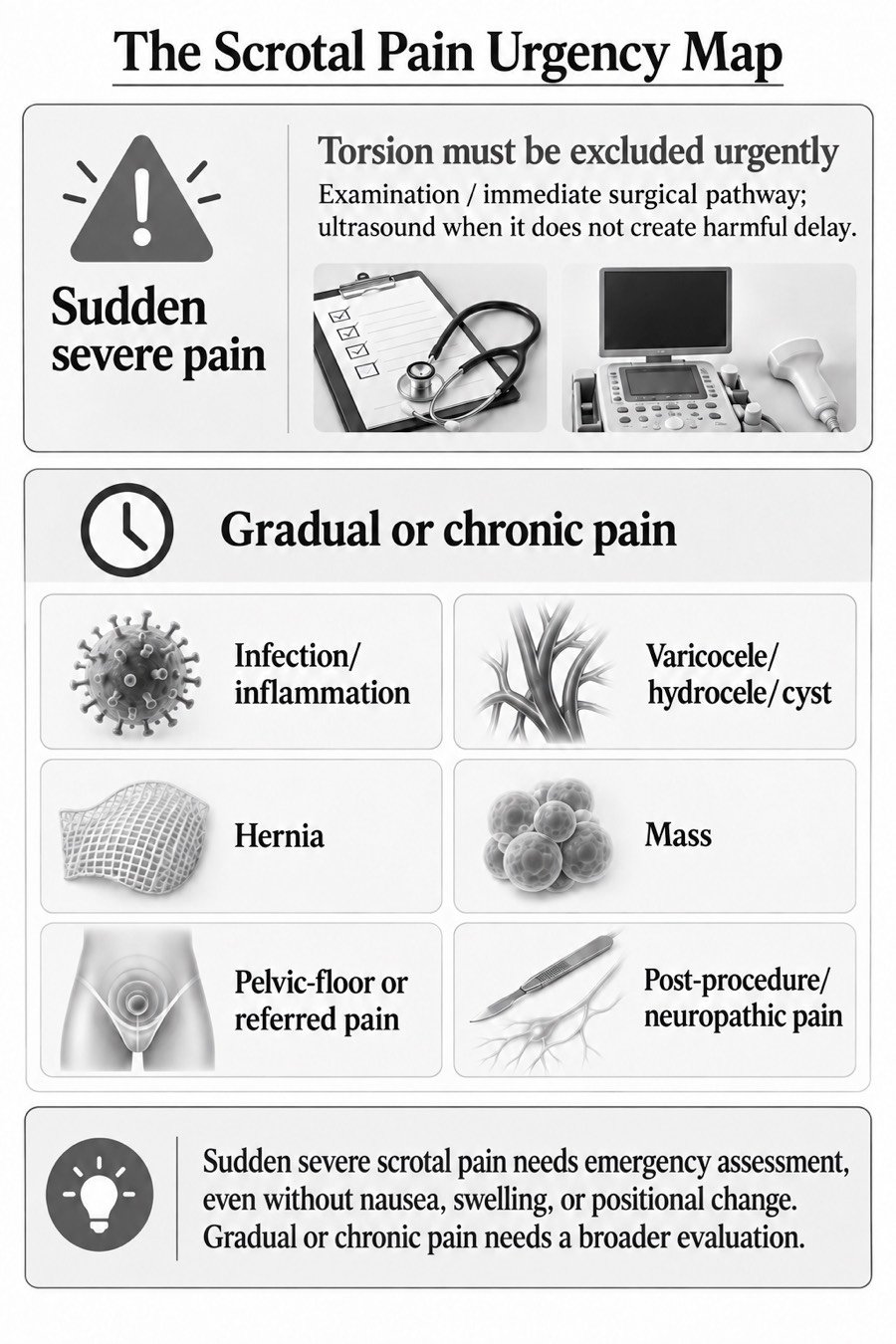
Sudden pain needs a different response
Sudden severe one-sided testicular pain, particularly with nausea or vomiting, may indicate torsion. Torsion threatens blood flow and must be assessed immediately. An ultrasound can help in selected circumstances, but concern about torsion should not be delayed while waiting for a routine office scan.
For other patterns, describe the location, onset, swelling, fever, urinary symptoms, injury, prior surgery and whether standing, activity or ejaculation changes the pain. A new lump deserves examination even if it is painless. Ultrasound can help distinguish a testicular finding from a fluid collection, cyst or other surrounding structure when indicated.
A finding on the scan may not explain every symptom
Infection, a hydrocele, a varicocele, an epididymal cyst or a hernia may be part of the discussion, but an incidental finding does not always identify the pain generator. The clinician should consider whether the examination, symptom pattern and imaging point in the same direction.
Persistent pain can include pelvic-floor, referred or neuropathic components. Treatment is directed toward the supported cause and may involve observation, medication, rehabilitation, a procedure or specialist care. Before an intervention for chronic pain, ask what makes that structure the likely source, what improvement is realistic and what will happen if pain persists. A follow-up plan should address both the medical finding and its effect on work, sleep, exercise and intimacy.
Questions to bring to your visit
- Has an urgent threat to blood flow or serious infection been excluded?
- Does the examination support the scan finding as the cause of pain?
- What is the next step if symptoms persist after initial treatment?
When to seek care: Sudden severe testicular pain is an emergency. Seek urgent assessment for rapidly increasing swelling, severe illness, a new mass or significant injury.
Explanation adapted from A Urology Consult in a Book by David Shusterman, MD, chapter 16, “Testicular And Scrotal Pain.” Original illustration reproduced from the book. EAU: urological health guidance.
Prepare for your visit with a book by Dr. David Shusterman
A Urology Consult in a Book explains symptoms, evaluation and treatment choices. Bring your questions to your clinician; the book supports that conversation.
Explore the books and care team →Take care of the basics.
Book a men's-health visit at our Manhattan or Forest Hills office — a simple step that's easy to keep putting off.

Manhattan & Queens · All Five Boroughs